Registry Intelligence / Knowledge Library / Amazon Marketplace Compliance
Amazon Marketplace Compliance Guides for Private-Label Sellers
Free, source-led answers to Amazon marketplace compliance questions involving product classification, testing, certificates, tracking labels, verification requests, and evidence submissions.
Every guide keeps the searchable HTML answer, decision path, detailed article, visual PDF, review date, and current primary sources together.
- 4
- Focused questions
- 4
- Detailed research pages
- 4
- Visual PDF guides
- 58
- Visual guide pages
Collection reviewed
Focused-question collection
Current Amazon and private-label questions
Start with the exact problem. Expand one guide for the short answer, decision controls, visual walkthrough, detailed analysis, and official-source trail.
4 focused questions are available.
No guide matches this search yet. Clear the search or choose another topic.
 Certificates & supplier evidence
Can You Use Your Supplier’s CPC or GCC for an Amazon Private-Label Product?
If you import a foreign-made private-label product into the United States, you generally cannot pass the foreign supplier’s CPC or GCC through as your own finished-product certificate. The importer must issue the certificate…
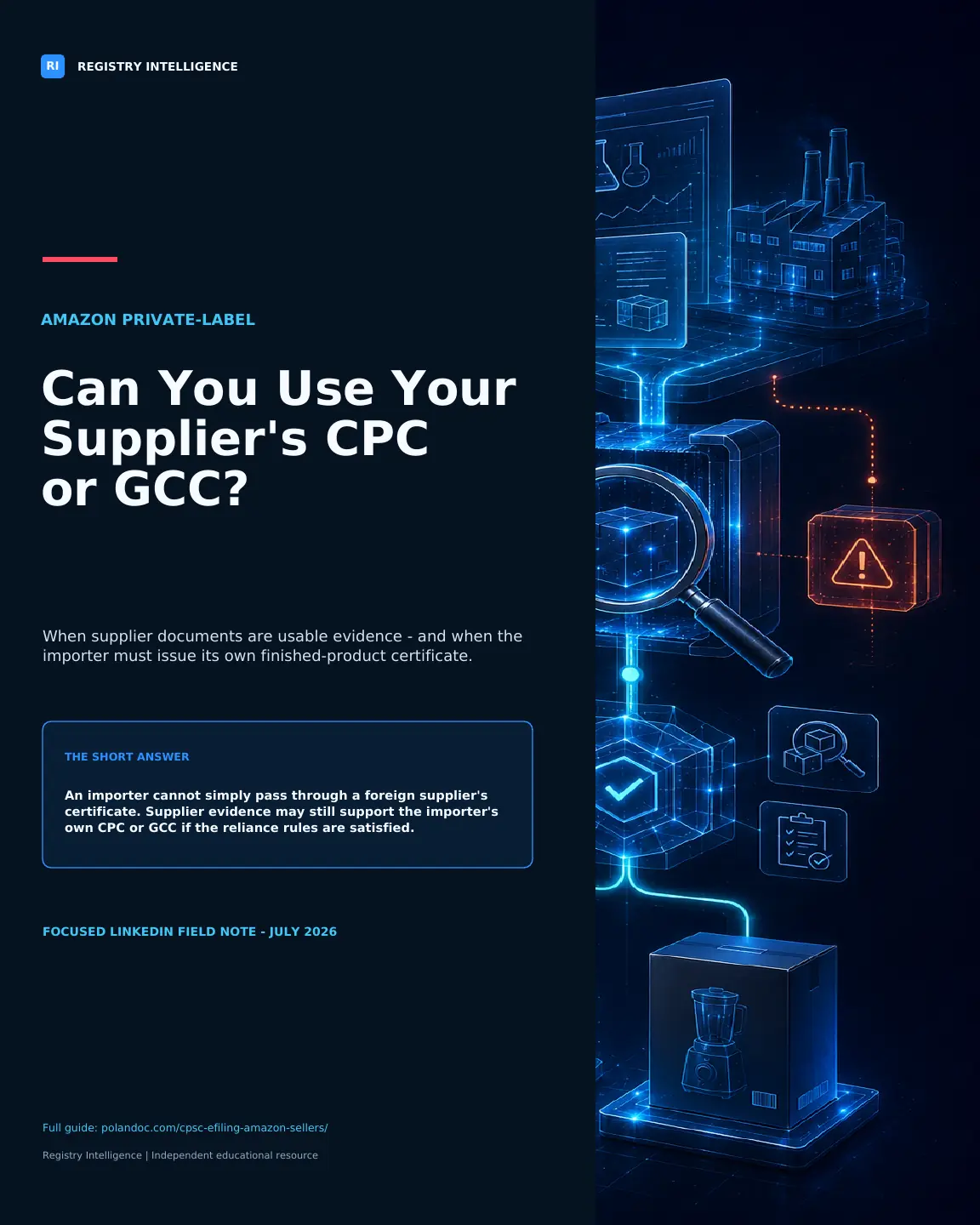
Free visual mini-guide · 7 pages · PDF and online viewer
Short answer
If you import a foreign-made private-label product into the United States, you generally cannot pass the foreign supplier’s CPC or GCC through as your own finished-product certificate. The importer must issue the certificate. Supplier testing or certification may still support it, but only after the importer verifies the exact product, applicable requirements, testing, traceability, and supporting records under the applicable reliance rules.
Decision path
01 / Input
Supplier package
Certificate, laboratory report, and supporting records.
02 / Control
Importer verification
Role, exact-product match, scope, dates, factory, and changes.
03 / Output
Correct CPC or GCC
The responsible certifier issues the finished-product certificate.
What the seven-page mini-guide covers
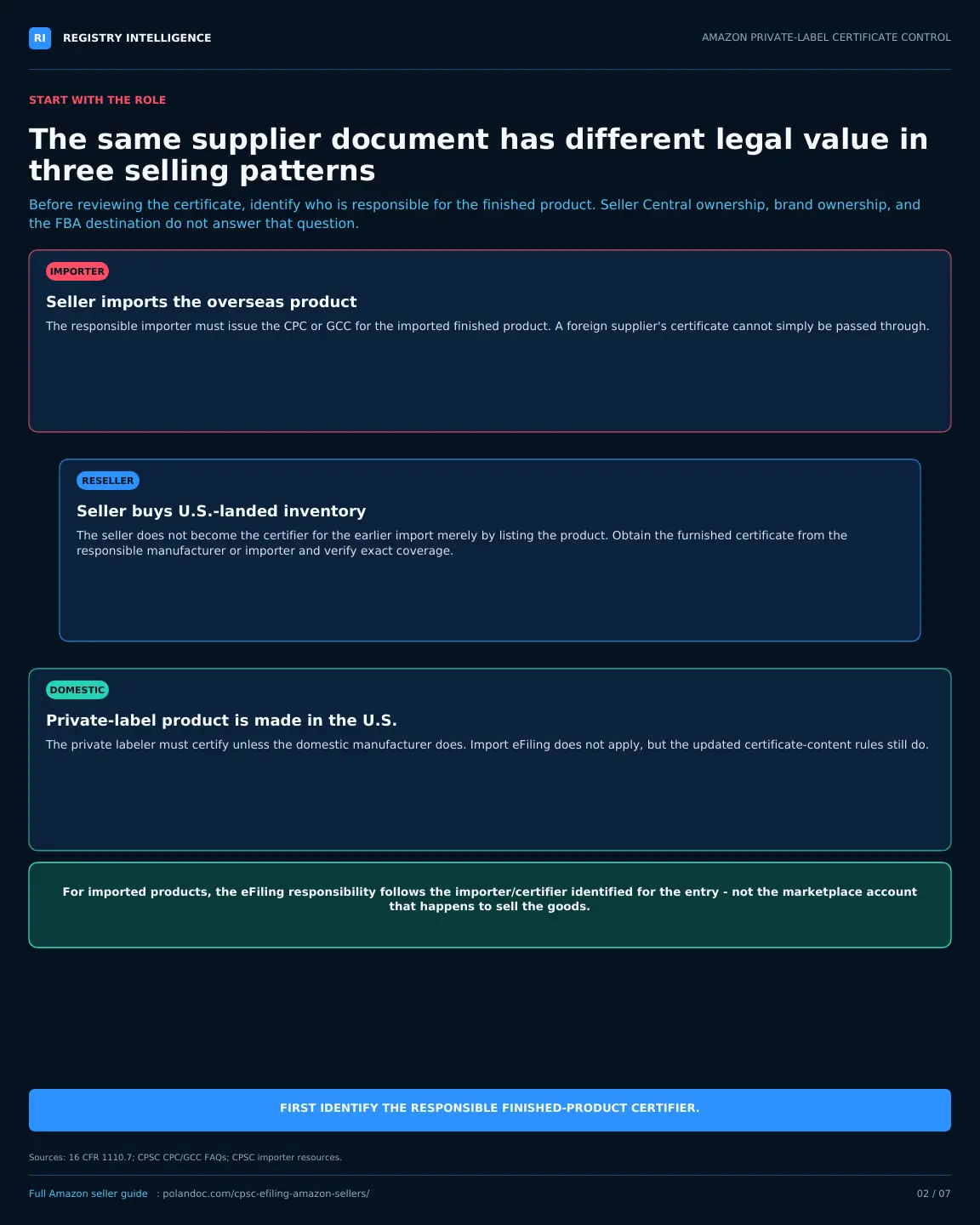
- How importer, U.S. reseller, and domestic private-label roles change the answer.
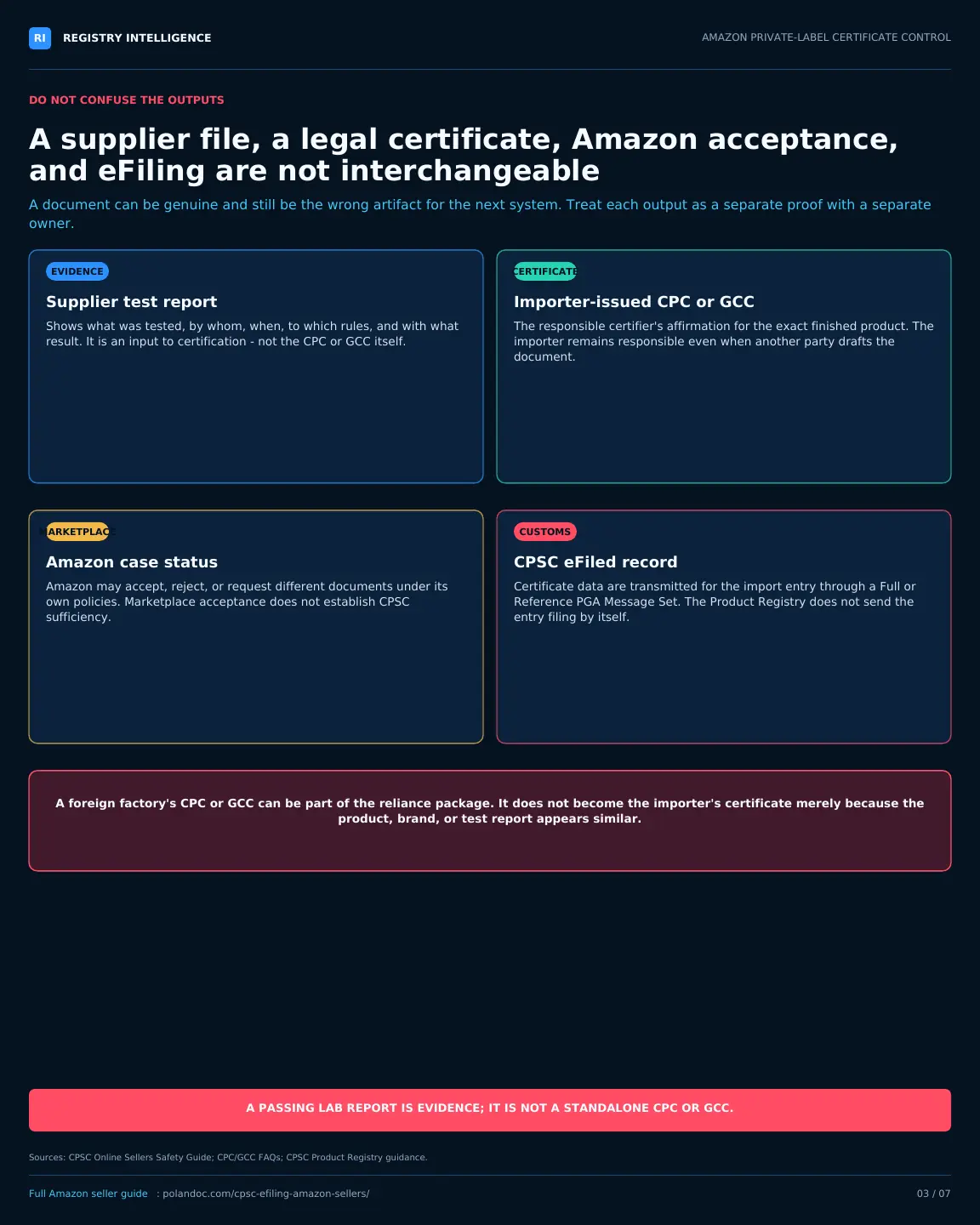
- The difference between a supplier test report, a legal certificate, Amazon acceptance, and a CPSC eFiled record.
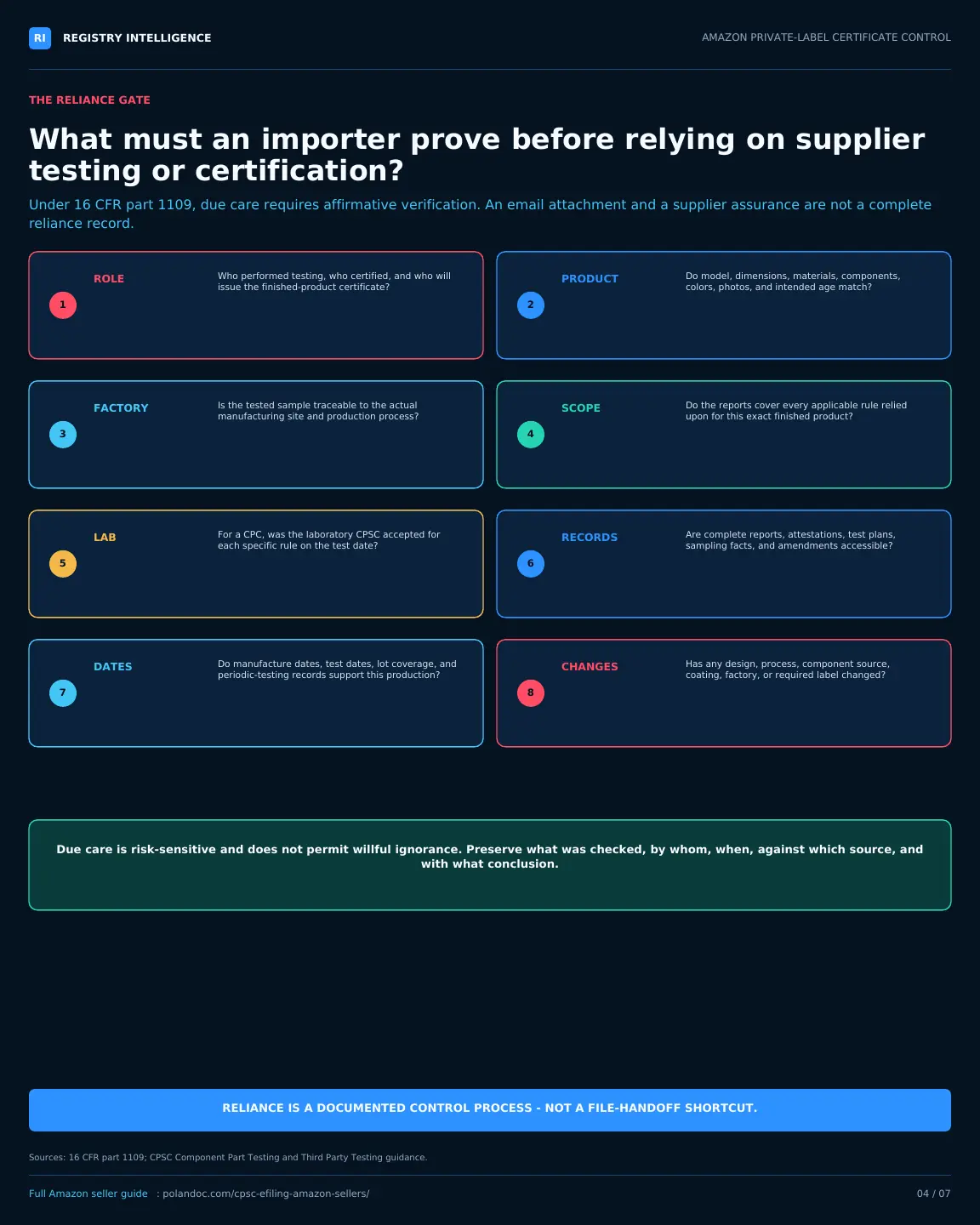
- The evidence an importer should verify before relying on supplier testing or certification.
- When a branding-only change may remain covered and when a material change requires reassessment or retesting.
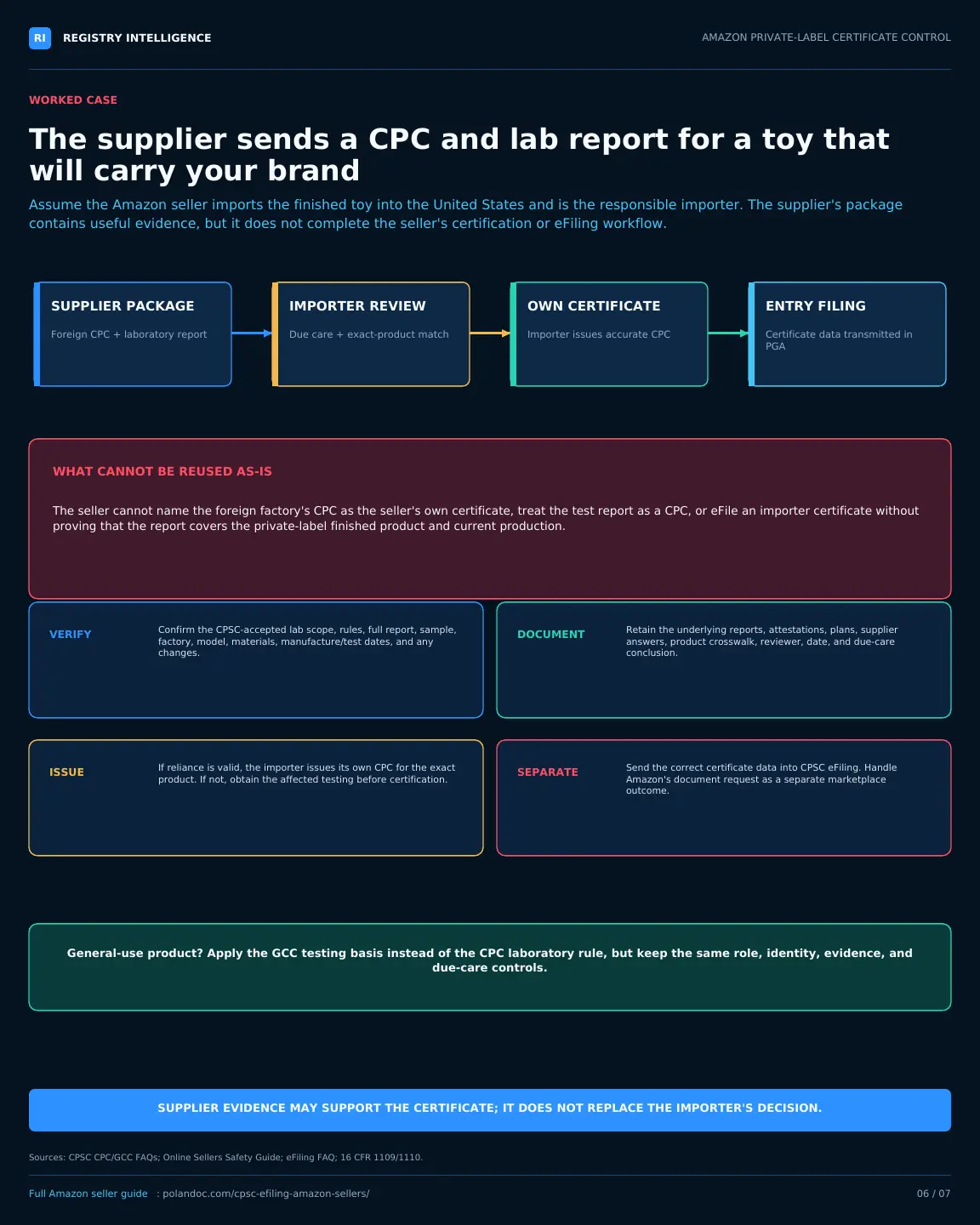
- A worked toy example from supplier package through importer certificate and entry filing.
Format7-page PDF
AudienceAmazon and private-label importers
Reviewed
Viewer page images
- Cover: Can You Use Your Supplier’s CPC or GCC?
- Start with the role: importer, reseller, or domestic private-label seller
- Do not confuse supplier evidence, legal certificates, Amazon acceptance, and CPSC eFiling
- Reliance gate: what an importer must verify before relying on supplier testing or certification
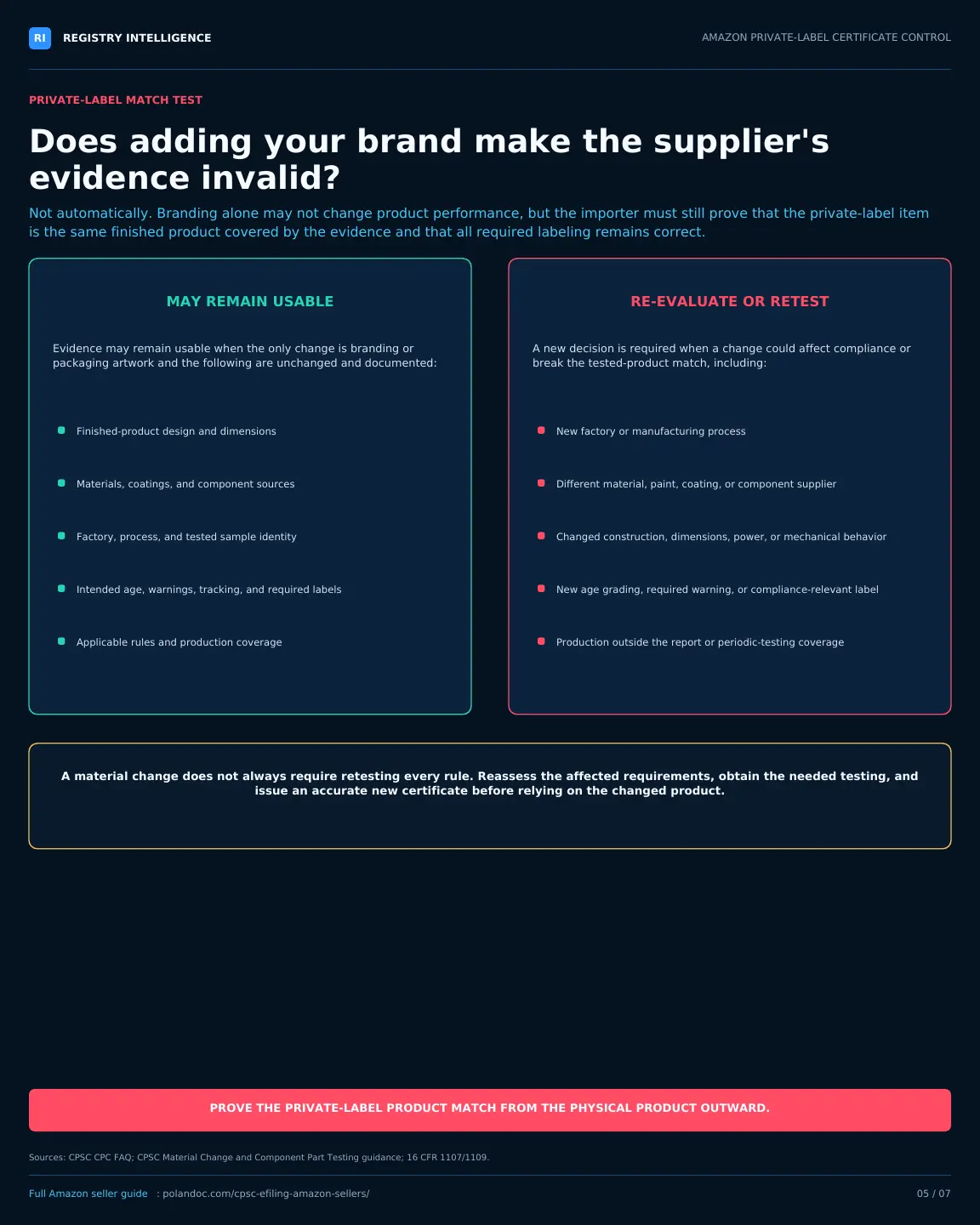
- Private-label match test: when adding your brand may require reevaluation or retesting
- Worked case: supplier CPC and lab report for an imported private-label toy
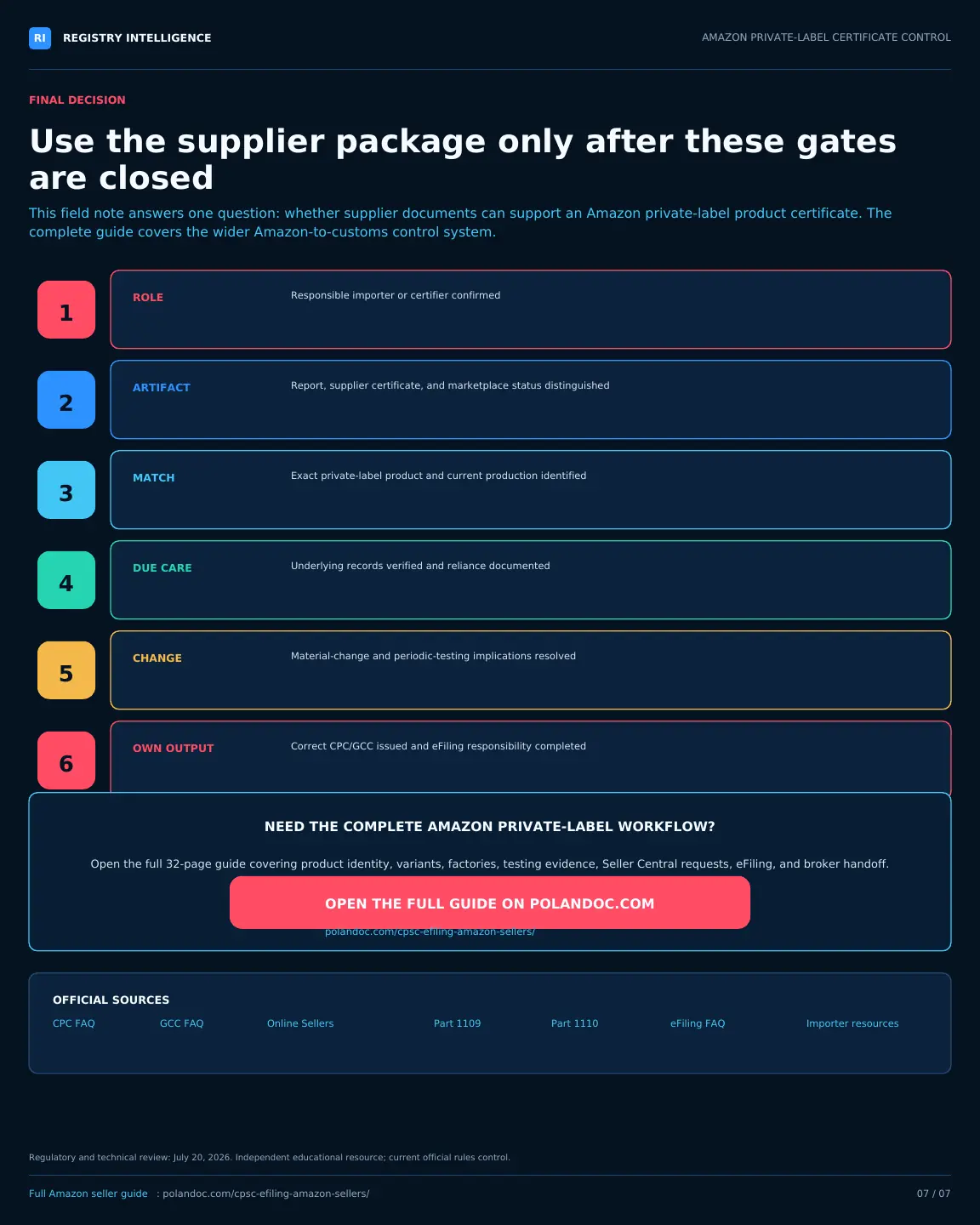
- Final decision checklist: use supplier evidence only after six control gates are closed
 Testing & Amazon verification
Does Amazon’s Annual Toy Verification Require New Testing and a New CPC?
No—not automatically. Amazon’s annual Direct Validation event may use document verification when the seller has a current, complete U.S. test report that matches the exact toy. A report older than 12 months generally requires…
Free visual mini-guide · 7 pages · PDF and online viewer
Short answer
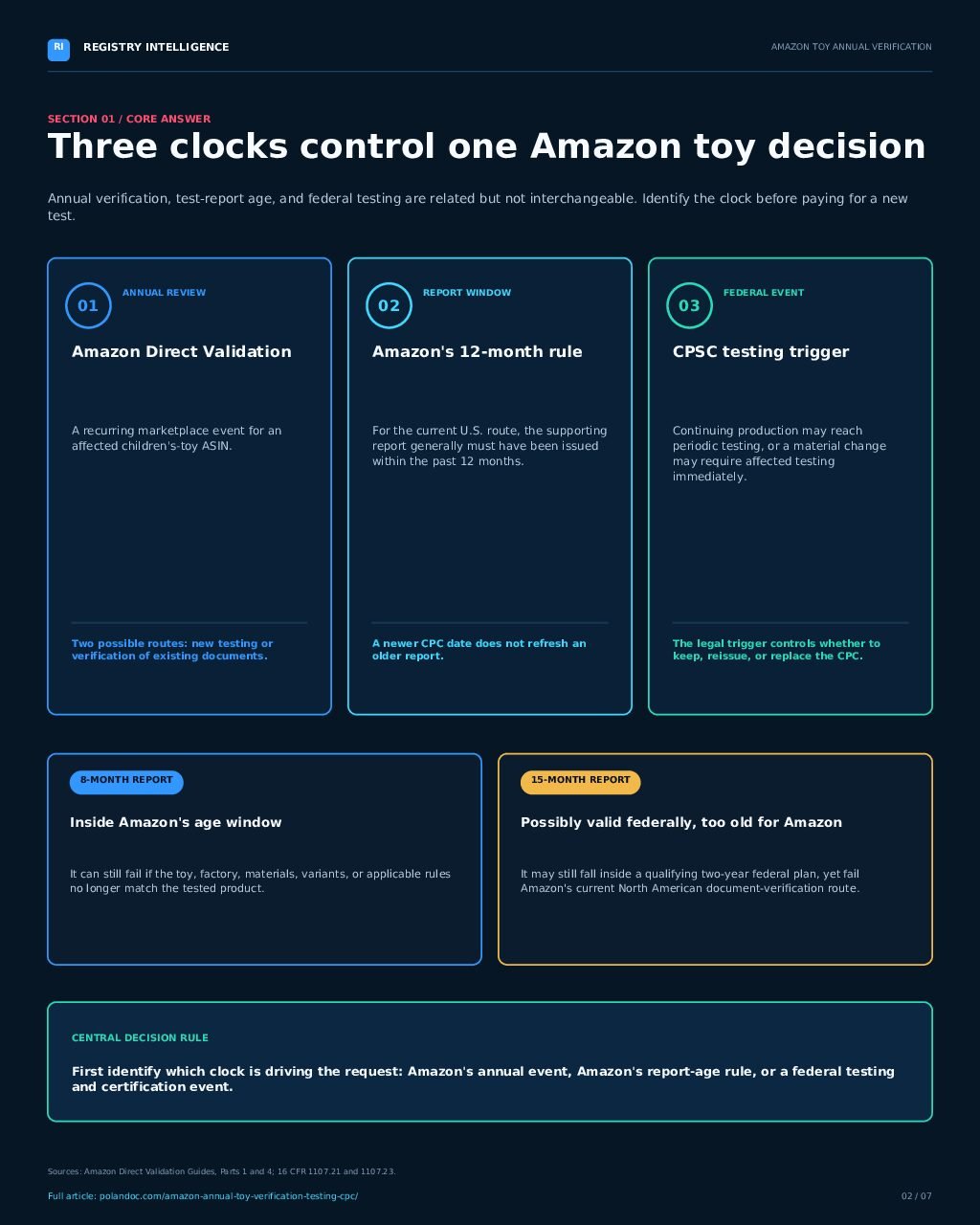
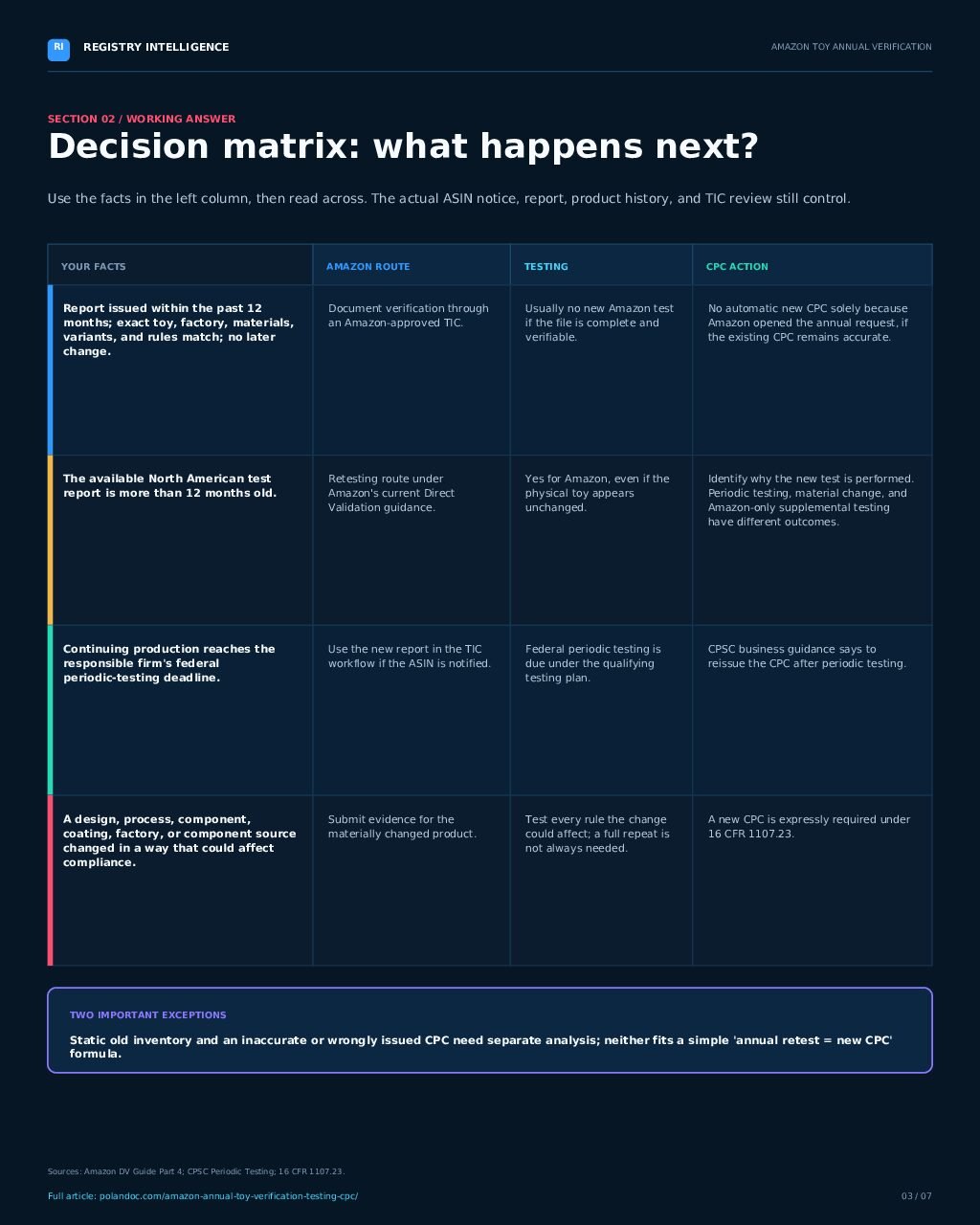
No—not automatically. Amazon’s annual Direct Validation event may use document verification when the seller has a current, complete U.S. test report that matches the exact toy. A report older than 12 months generally requires retesting for Amazon’s current North American route. The CPC question is separate: Amazon does not publish a universal annual CPC-expiration rule, and the correct certificate action depends on why testing occurs, whether the product changed, and whether the existing CPC remains accurate.
Decision path
01 / Event
Annual Direct Validation
Amazon opens a new verification request for the affected toy ASIN.
02 / Evidence gate
Report age and exact match
Check the 12-month window, laboratory scope, product identity, and later changes.
03 / Outcome
Keep, reissue, or replace CPC
The reason for testing and certificate accuracy control the action.
What the seven-page mini-guide covers
- The three separate clocks: Amazon’s annual event, Amazon’s 12-month report window, and federal testing duties.
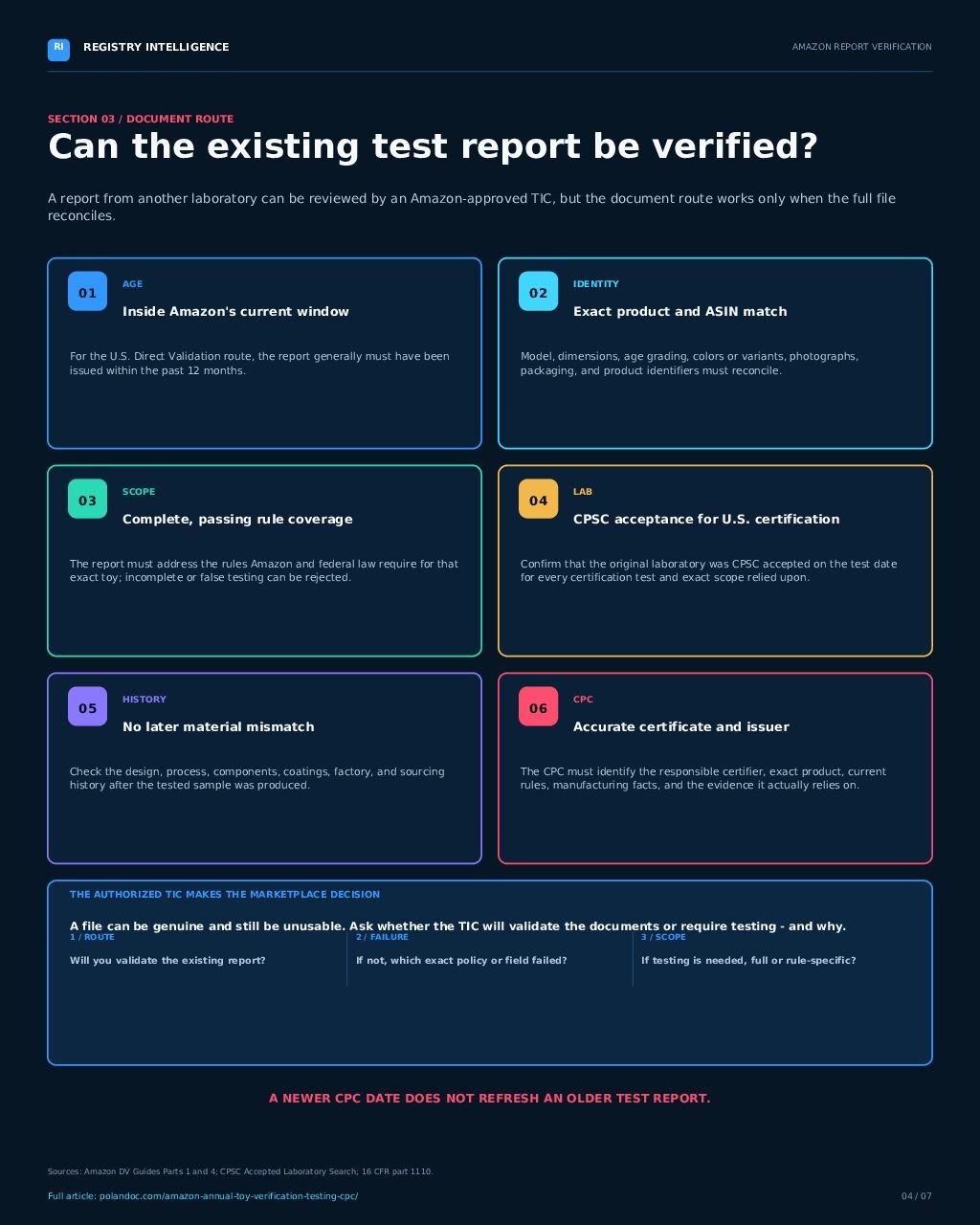
- When a current report may qualify for document verification and when Amazon generally requires retesting.
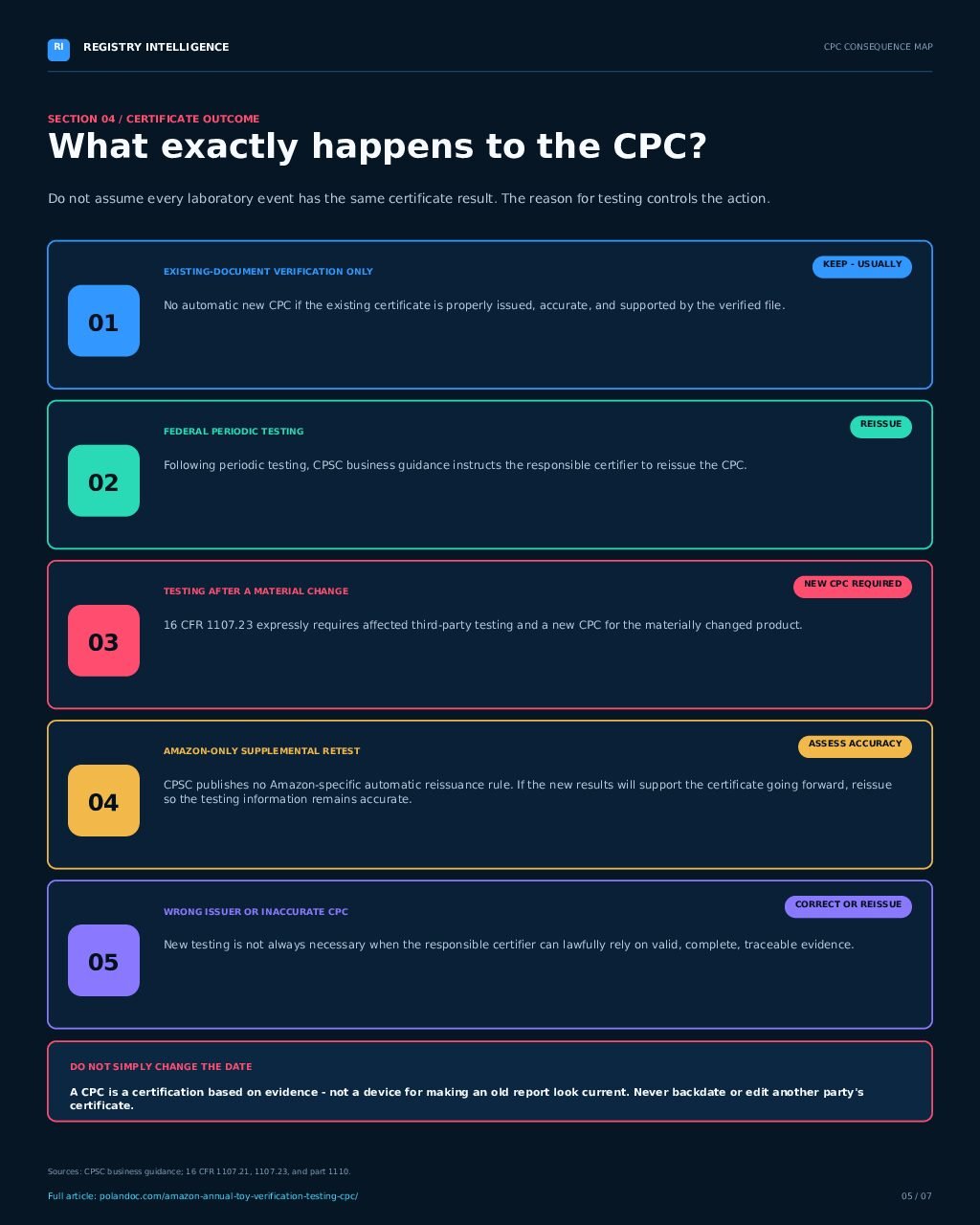
- How periodic testing, a material change, and Amazon-only supplemental testing lead to different CPC outcomes.
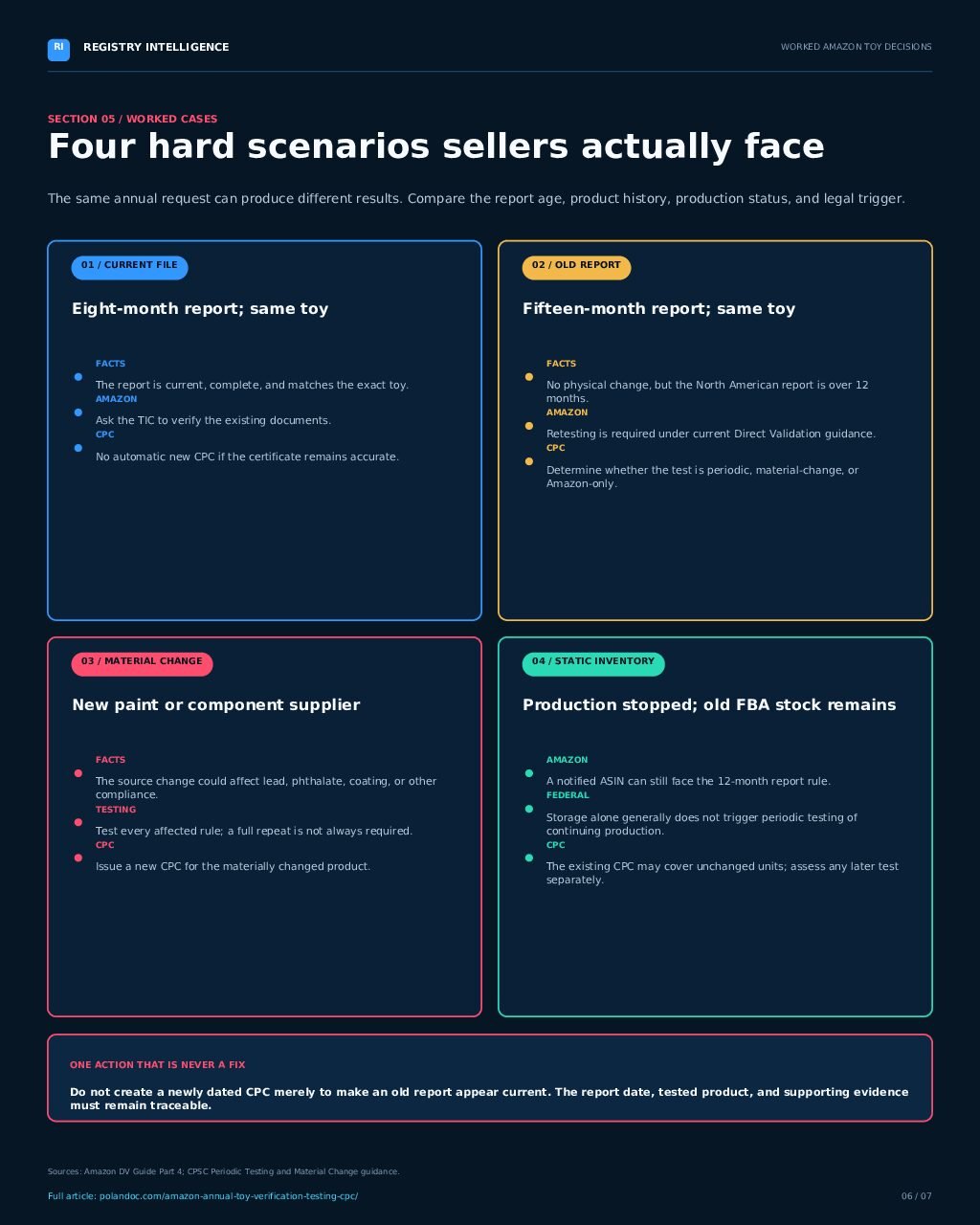
- Difficult scenarios involving old FBA inventory, changed products, inaccurate certificates, and mismatched evidence.
- A final checklist for the report, laboratory scope, exact toy, variants, factory, applicable rules, and CPC accuracy.
Format7-page PDF
AudienceAmazon children’s-toy sellers
Reviewed
Viewer page images
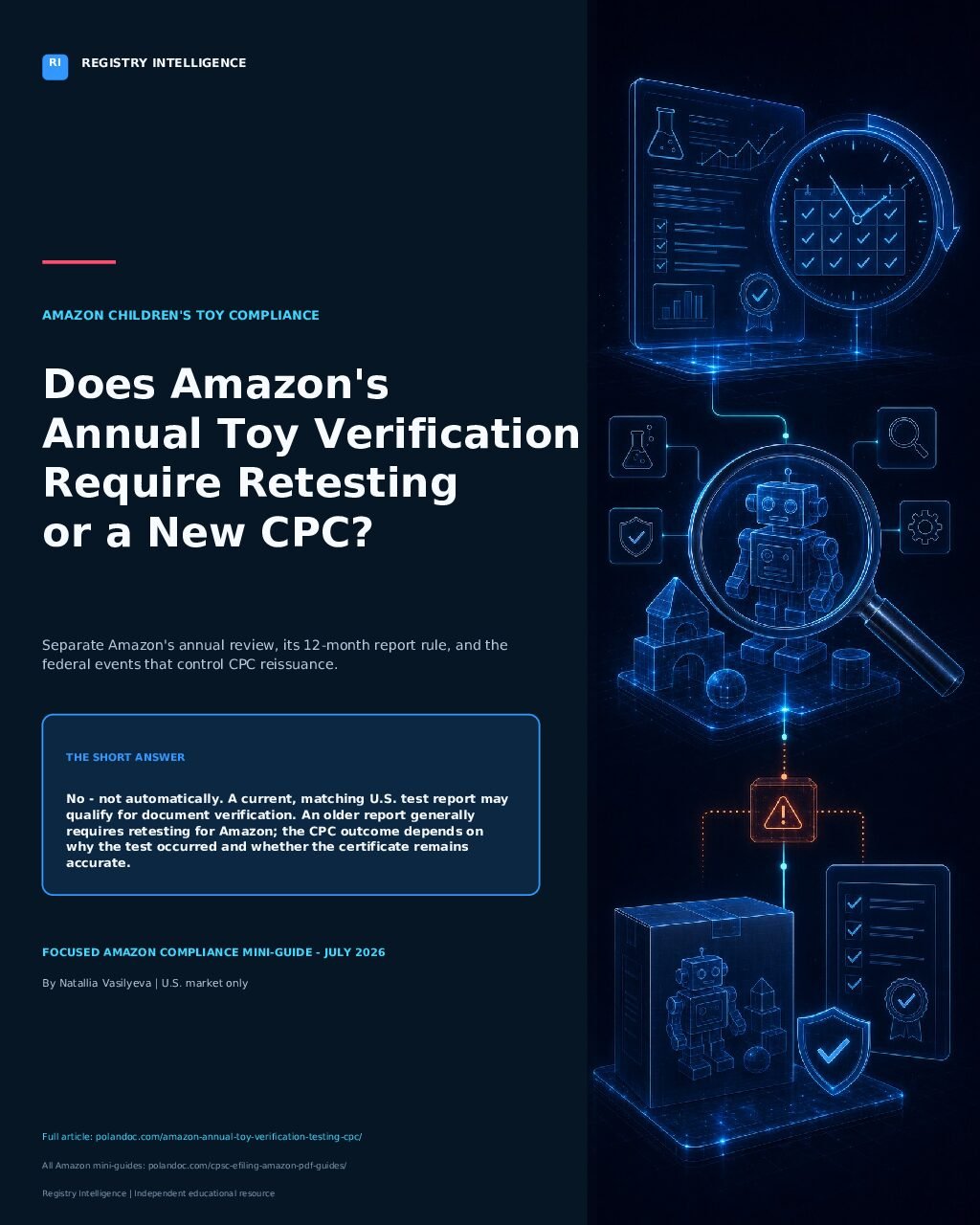
- Cover: Does Amazon’s Annual Toy Verification Require Retesting or a New CPC?
- Three clocks: Amazon annual review, the 12-month report window, and federal testing triggers
- Decision matrix: Amazon route, testing action, and CPC outcome for four fact patterns
- Existing-report verification: age, identity, scope, laboratory, product history, and CPC checks
- CPC consequence map: keep, reissue, create a new CPC, assess accuracy, or correct the issuer
- Four hard scenarios: current file, old report, material change, and old FBA stock
- Final checklist: read the notice, calculate report age, match the toy, identify the trigger, verify laboratory scope, and close the file

 Classification & misclassification appeals
Amazon Product Misclassified as a Children’s Toy? Should You Test or Appeal?
Do not test solely because Amazon flagged the ASIN as a children’s toy. Verify or test when the complete evidence shows a genuine children’s toy; appeal when the product is adult or general use; and correct inaccurate catalog…
Free visual mini-guide · 9 pages · PDF and online viewer
Short answer
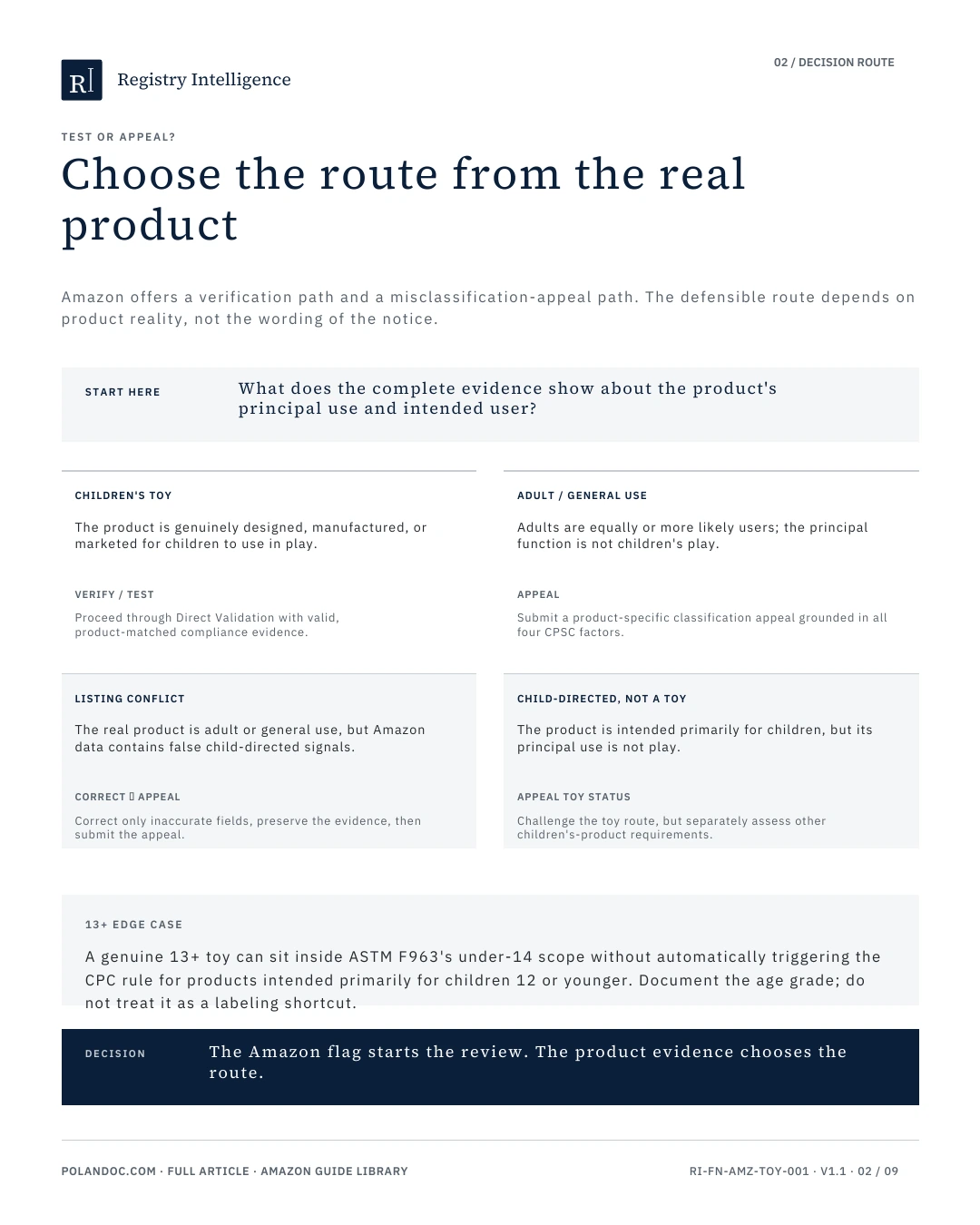
Do not test solely because Amazon flagged the ASIN as a children’s toy. Verify or test when the complete evidence shows a genuine children’s toy; appeal when the product is adult or general use; and correct inaccurate catalog data first when the Amazon listing contradicts the real product. The decision should follow the exact product, package, intended use, consumer recognition, age analysis, and play value—not the notice alone.
Decision path
01 / Classify
Review the real product
Identify principal function, intended user, age, package, marketing, and play value.
02 / Evidence
Apply all four factors
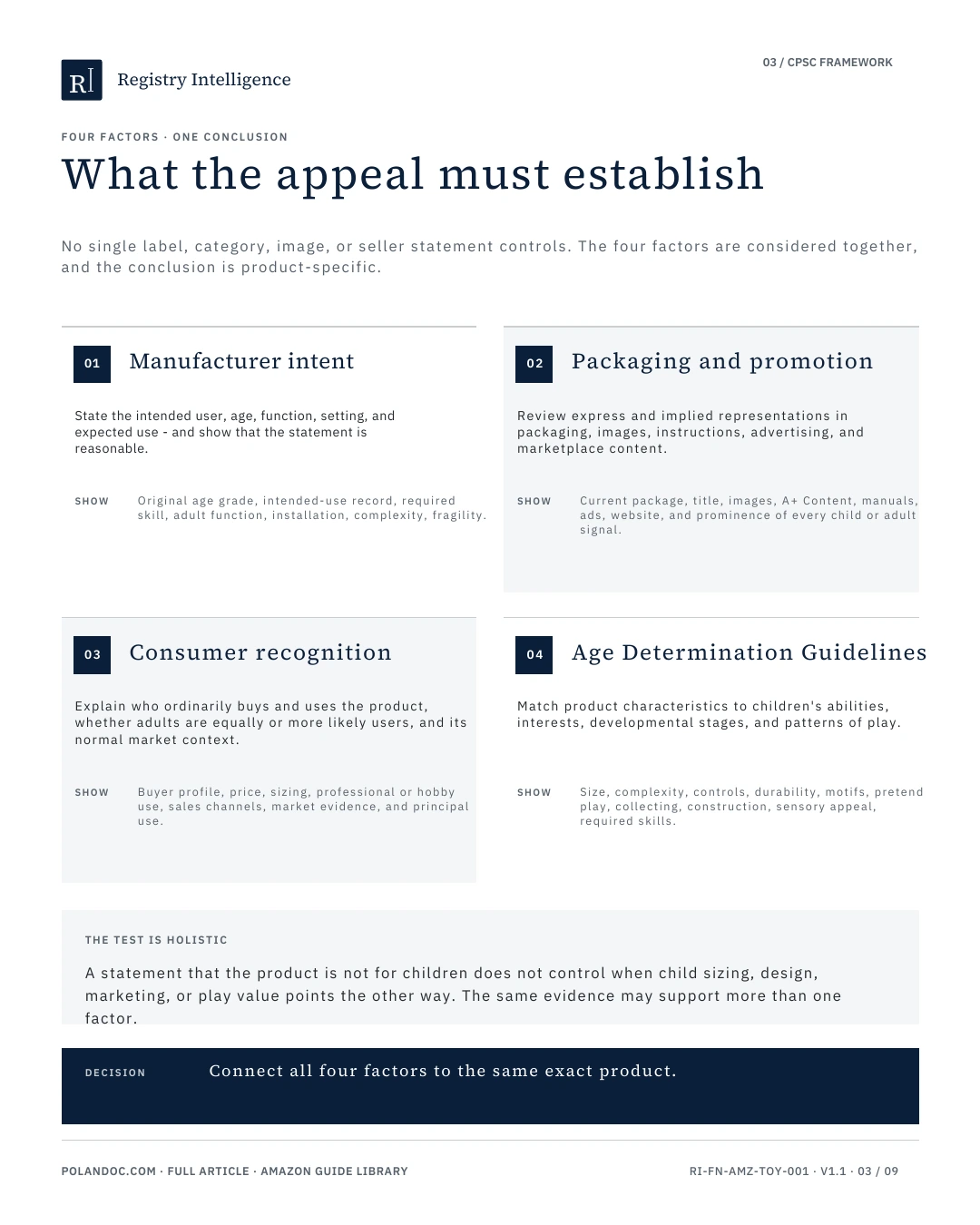
Connect intent, presentation, consumer recognition, and age guidance to the exact ASIN.
03 / Route
Test, appeal, or correct first
Choose the Amazon response that matches the complete and consistent product record.
What the nine-page mini-guide covers
- How to choose among verification or testing, a misclassification appeal, correcting the listing first, and challenging toy status while separately assessing other children’s-product rules.
- The federal four-factor framework: manufacturer intent, packaging and promotion, consumer recognition, and the CPSC Age Determination Guidelines.
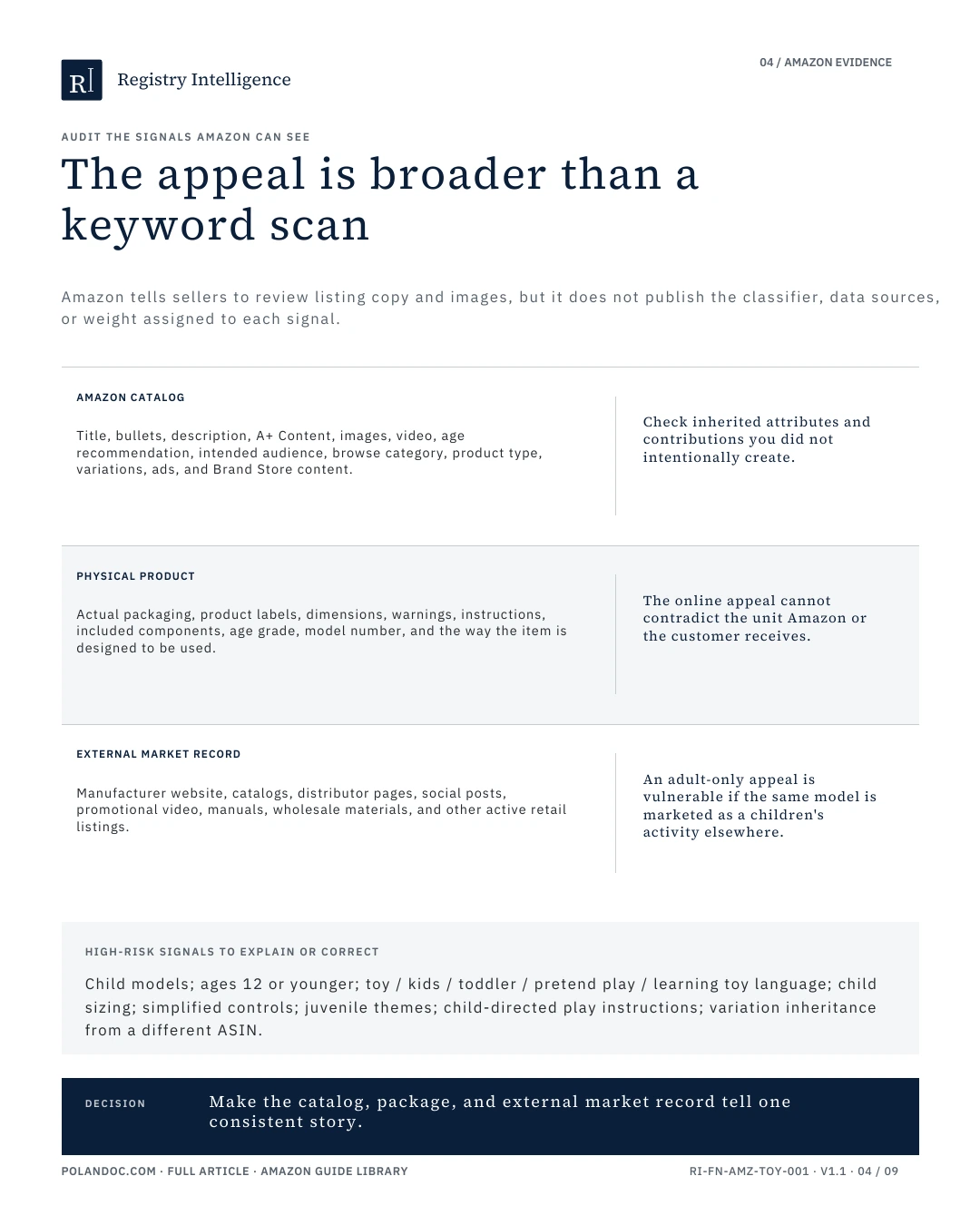
- How to audit the Amazon catalog, physical product and packaging, and external market record for contradictions.
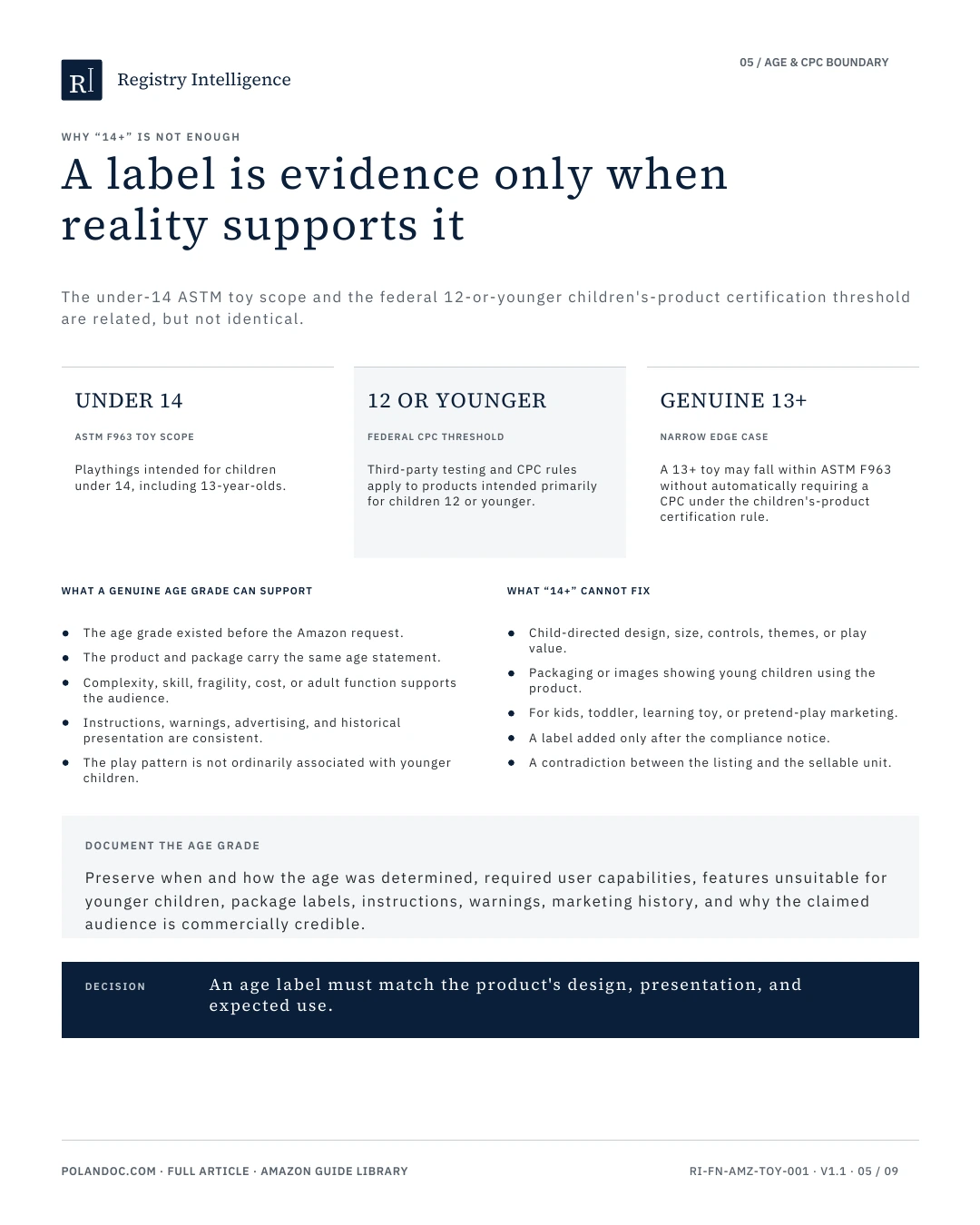
- Why a “14+” label is not enough and how the under-14 ASTM toy scope differs from the 12-or-younger CPC threshold.
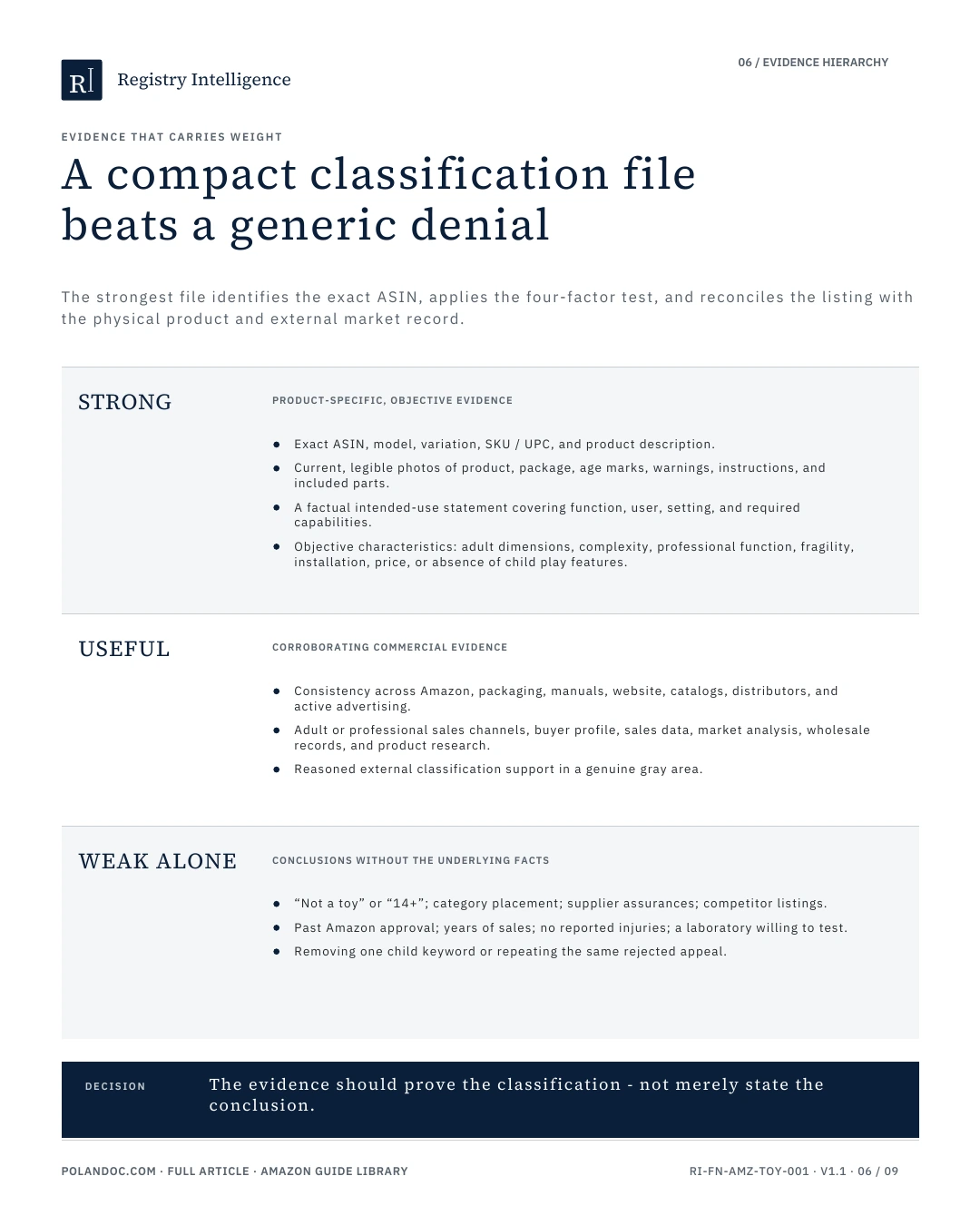
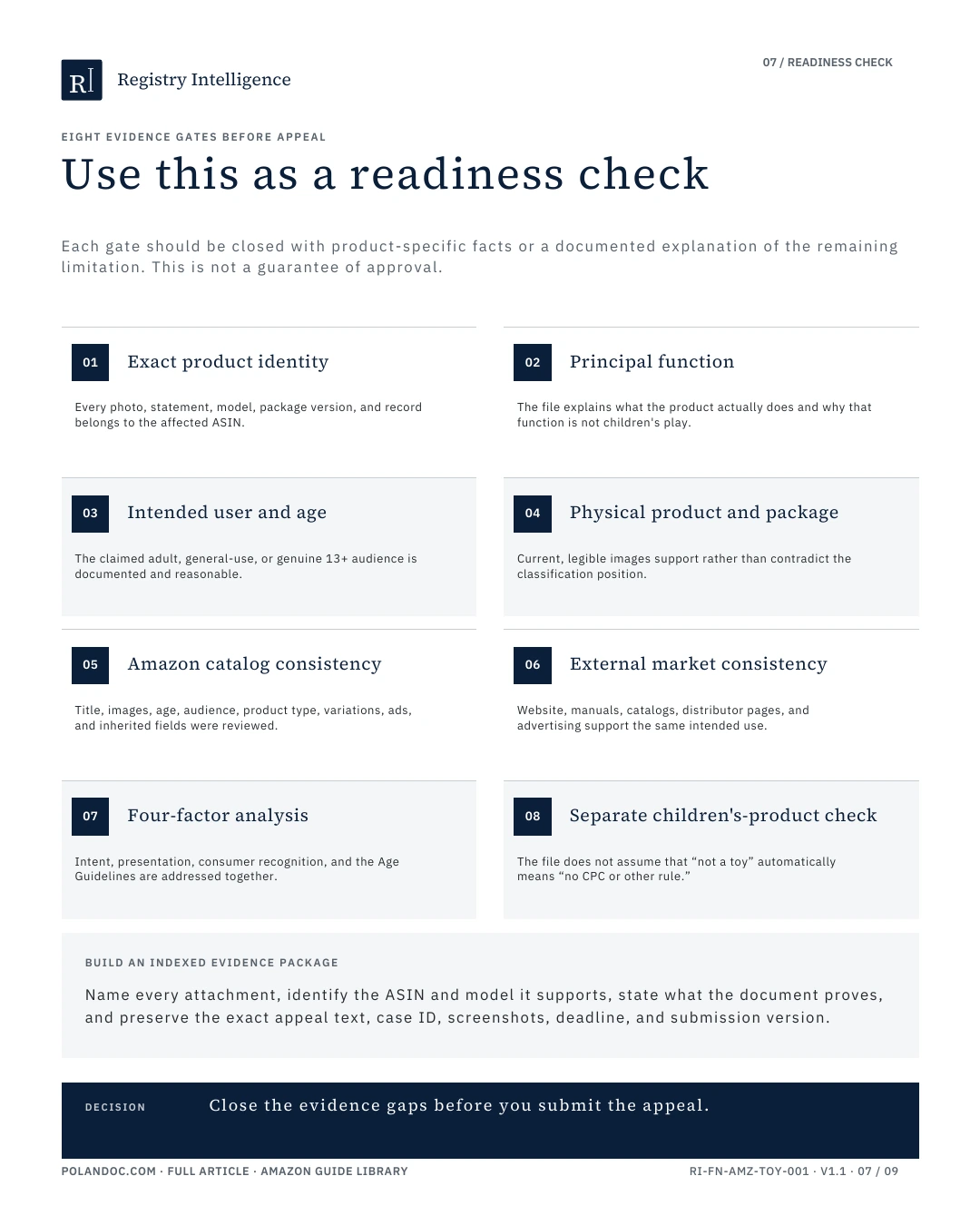
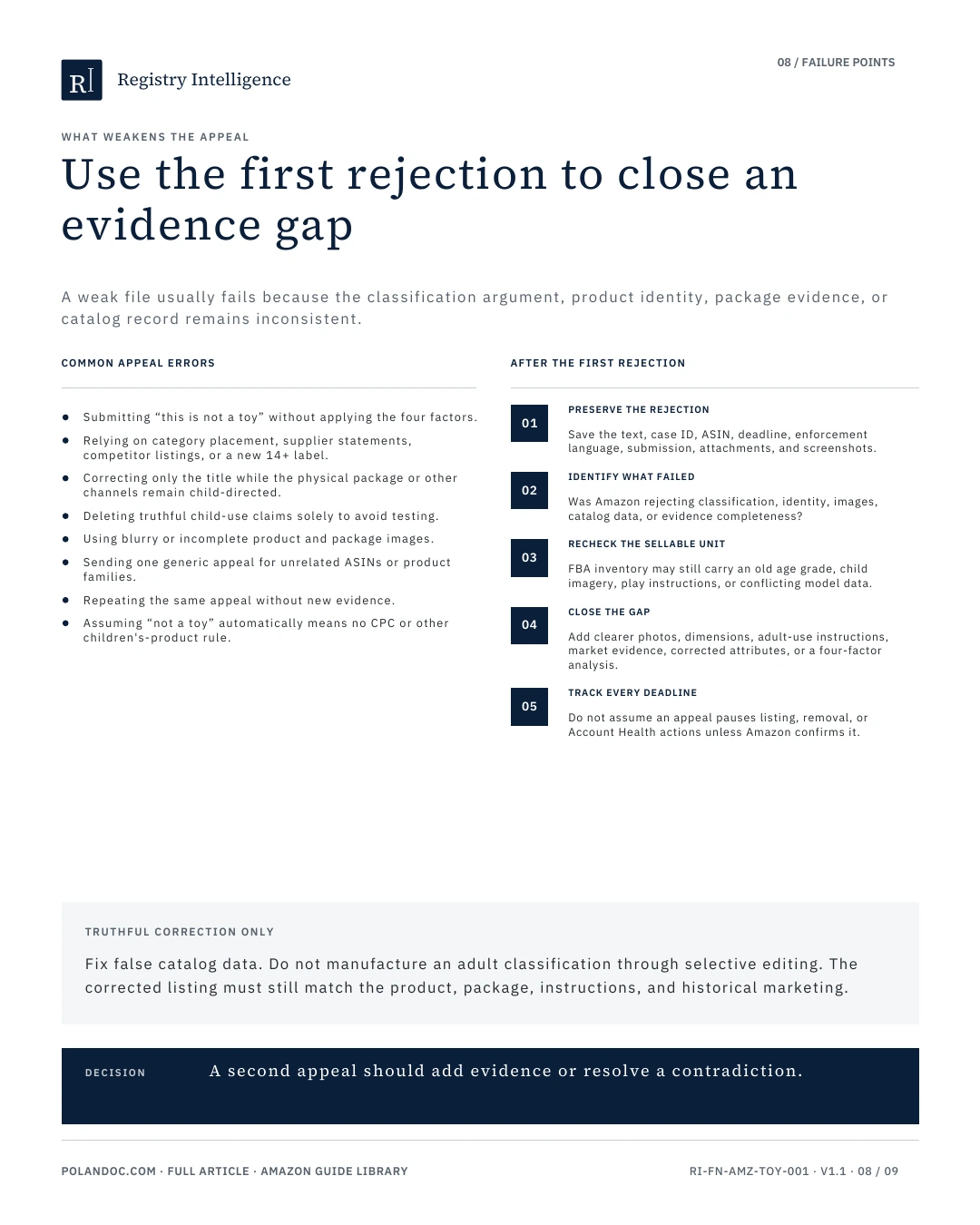
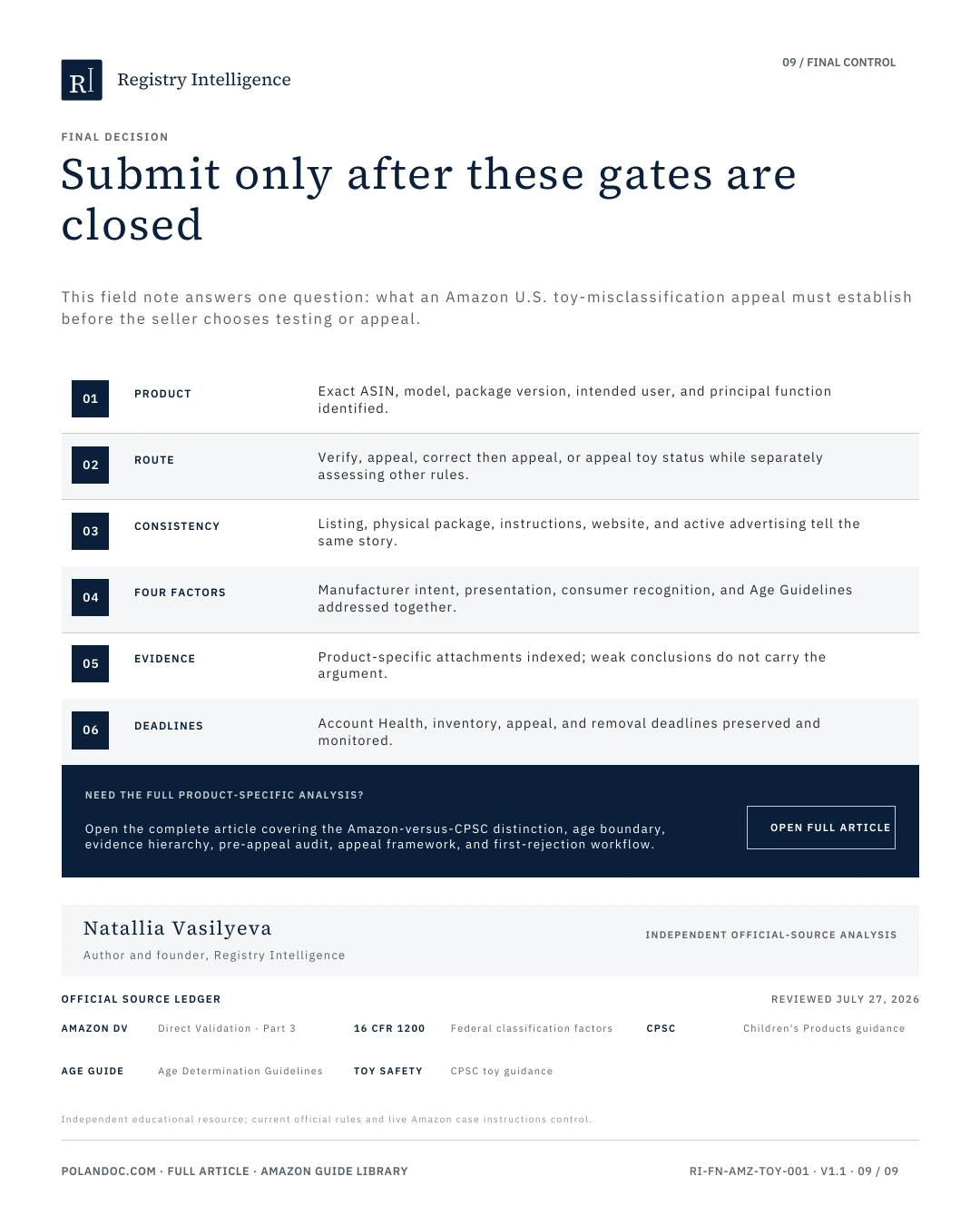
- The evidence hierarchy, eight readiness gates, common appeal failures, and the steps to take after a first rejection.
Format9-page PDF
AudienceAmazon sellers facing toy misclassification
Reviewed
Viewer page images
- Cover: Not a Toy. Still Flagged.
- Test or appeal: choose the route from the real product, not from the Amazon flag
- Federal four-factor framework: manufacturer intent, presentation, consumers, and age guidance
- Amazon-facing evidence: audit the catalog, physical product, and external market record
- Age grading and CPC boundary: why “14+” is not enough
- Appeal evidence hierarchy: product-specific evidence that carries weight
- Appeal readiness check: eight evidence gates before submission
- Appeal failure points: what weakens the file and what to do after rejection
- Final appeal control: submit only after the product, route, consistency, evidence, and deadline gates are closed
Tracking labels & image evidenceAmazon CPSIA Tracking-Label Image Review Workbook
Build one traceable chain from the exact child ASIN to the physical product, retail package, permanent marks, visible production code, decoder, and retained source record. Before resubmitting, separate classification…
Free visual workbook · 35 pages · PDF and online viewer
Short answer
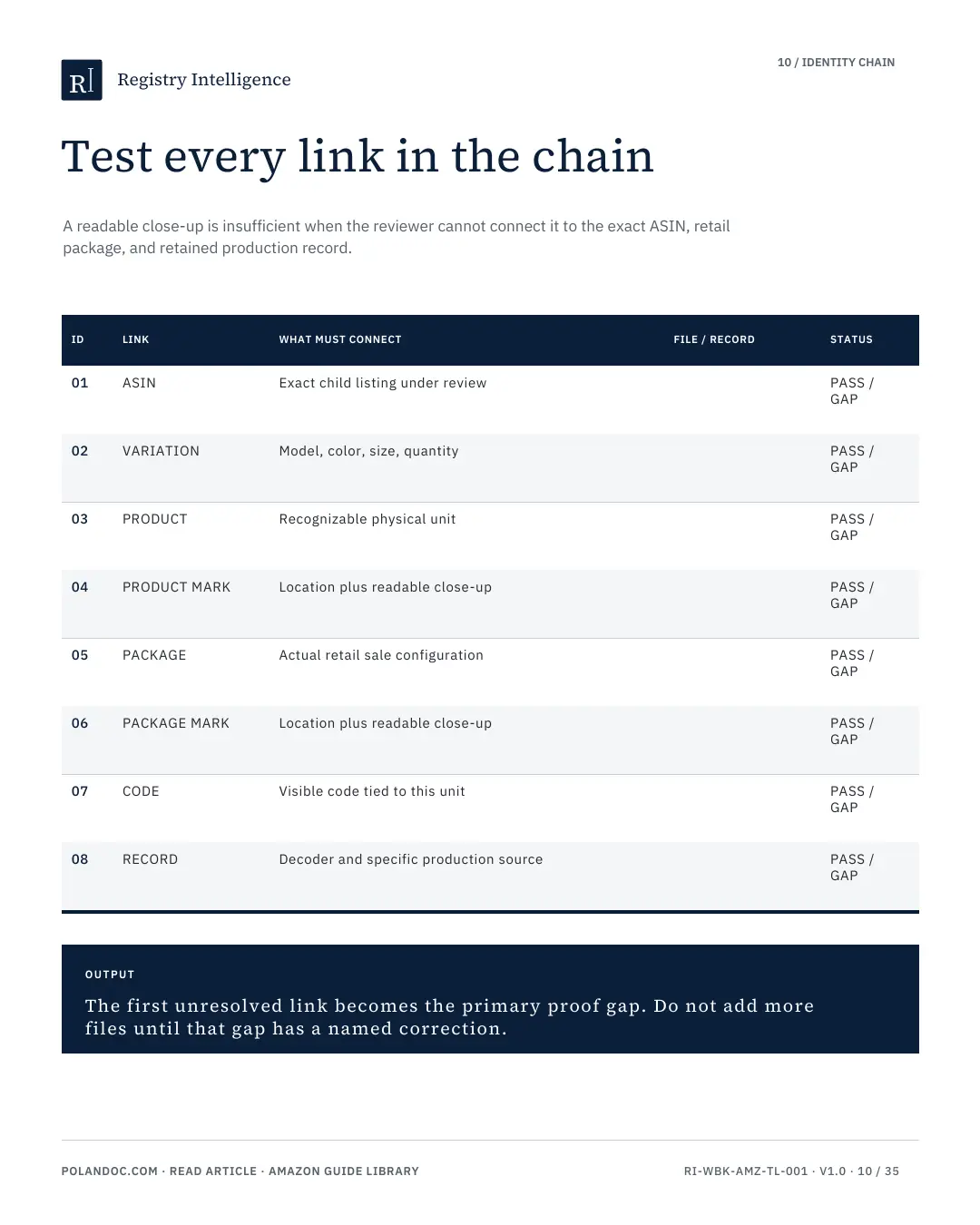
Build one traceable chain from the exact child ASIN to the physical product, retail package, permanent marks, visible production code, decoder, and retained source record. Before resubmitting, separate classification, physical-marking, identity, image-quality, coded-information, and additional-rule issues; then replace the old packet with one coherent, versioned evidence set that addresses the named rejection.
Decision path
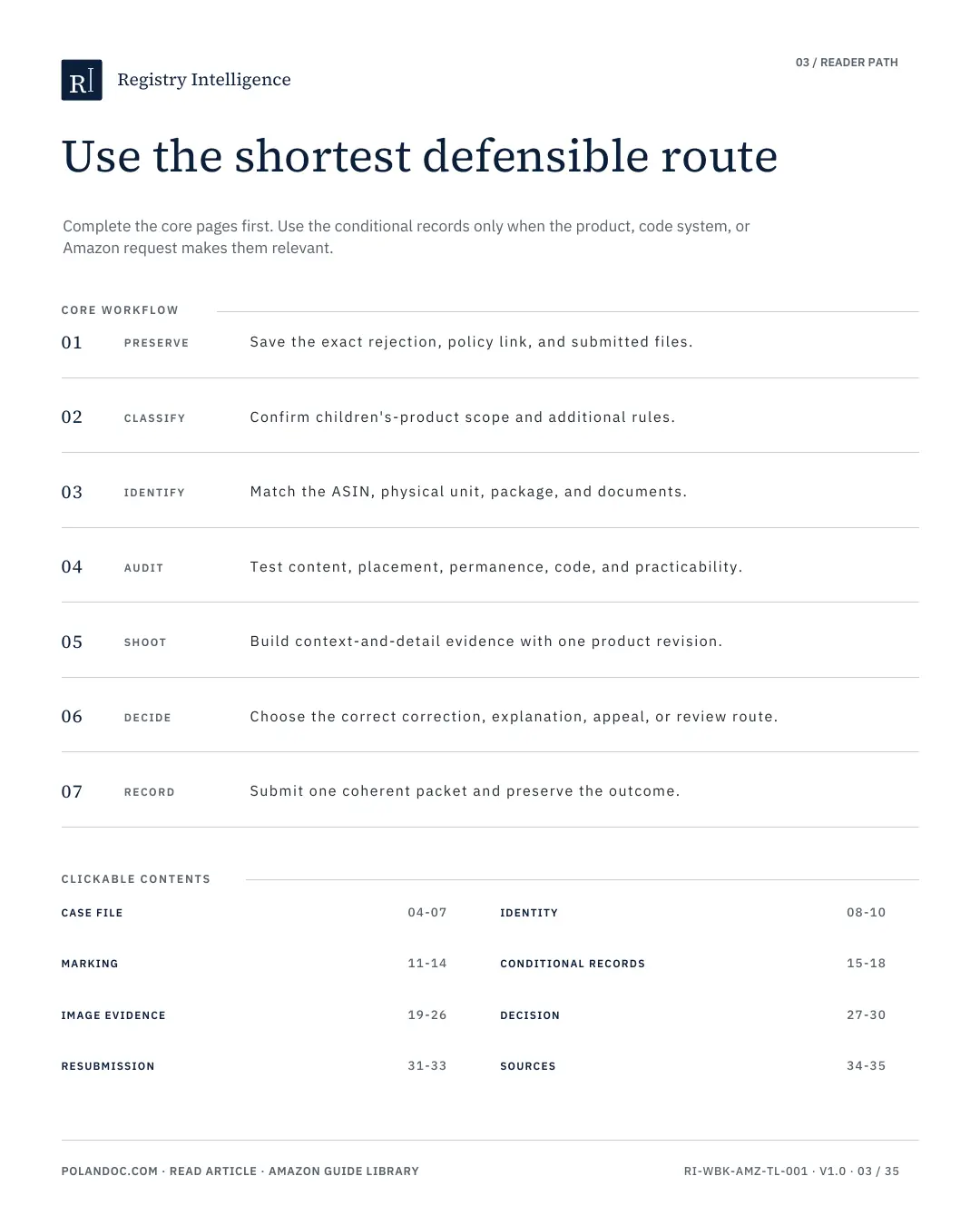
01 / Preserve
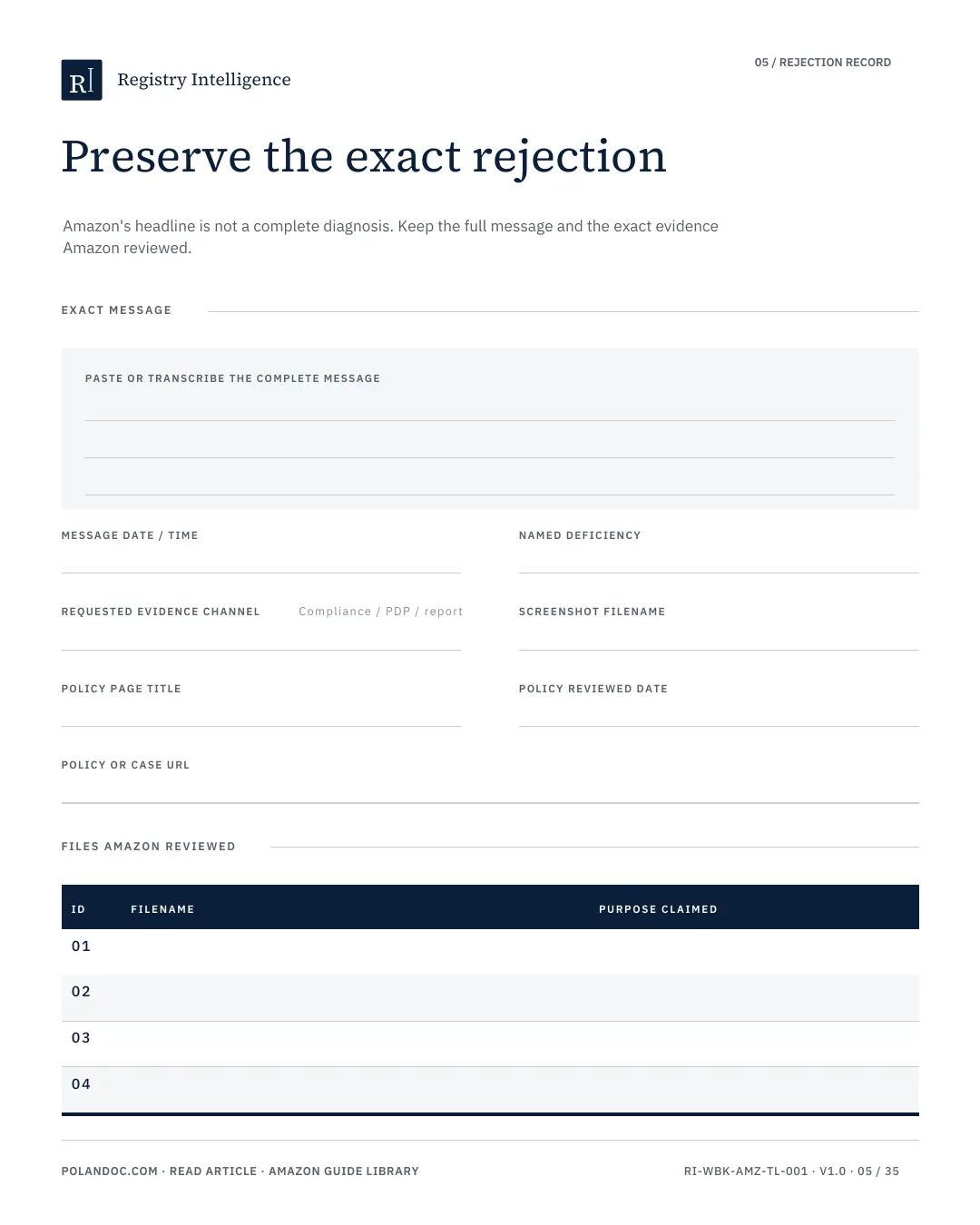
Freeze the rejection record
Keep the exact message, policy link, submitted files, ASIN, variation, and package revision.
02 / Audit
Test identity and marking
Check scope, product and package marks, permanence, code meaning, live images, and document consistency.
03 / Rebuild
Submit one controlled packet
Choose the correct route, reshoot only what is needed, remove contradictions, and preserve every outcome.
What the 35-page workbook covers
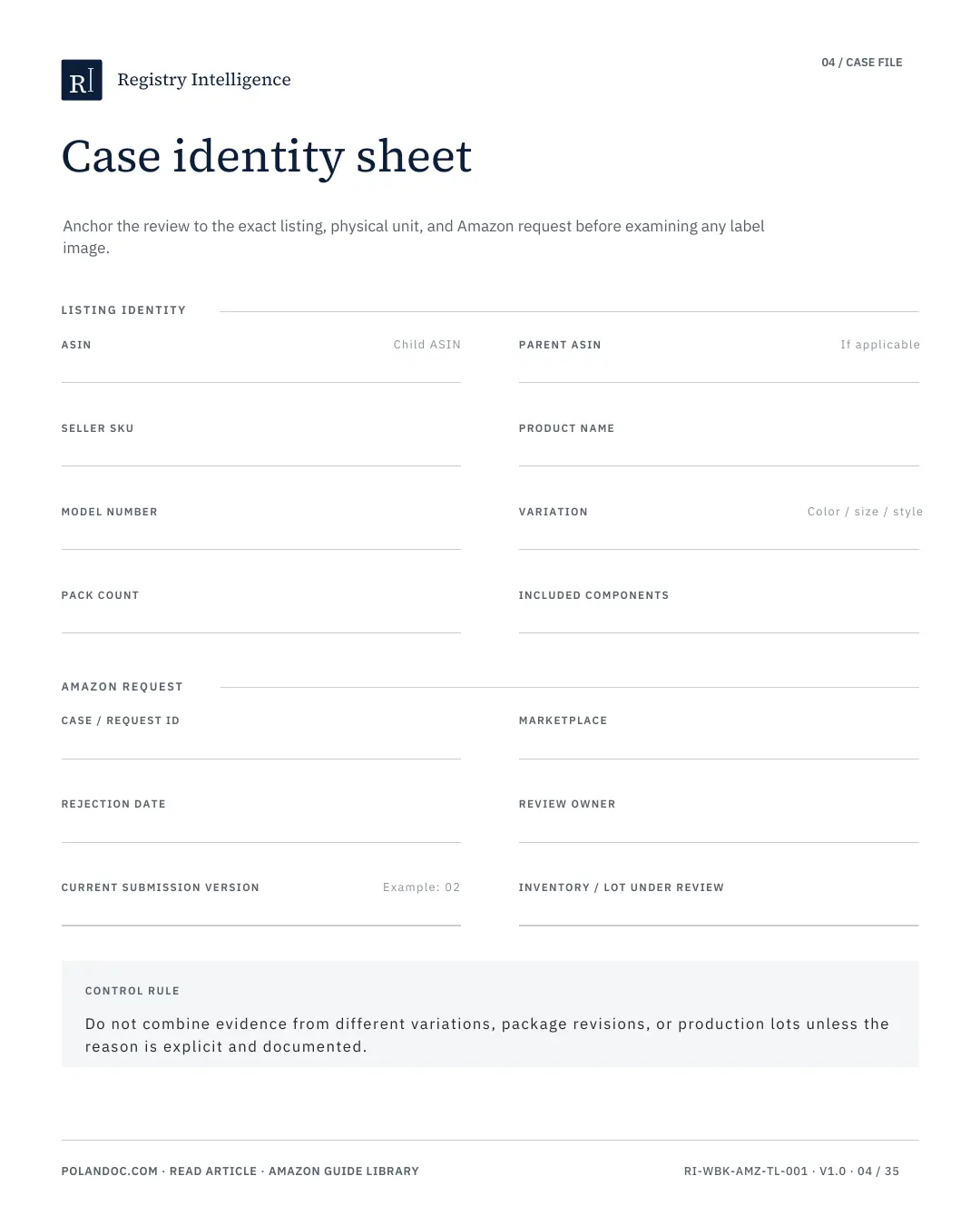
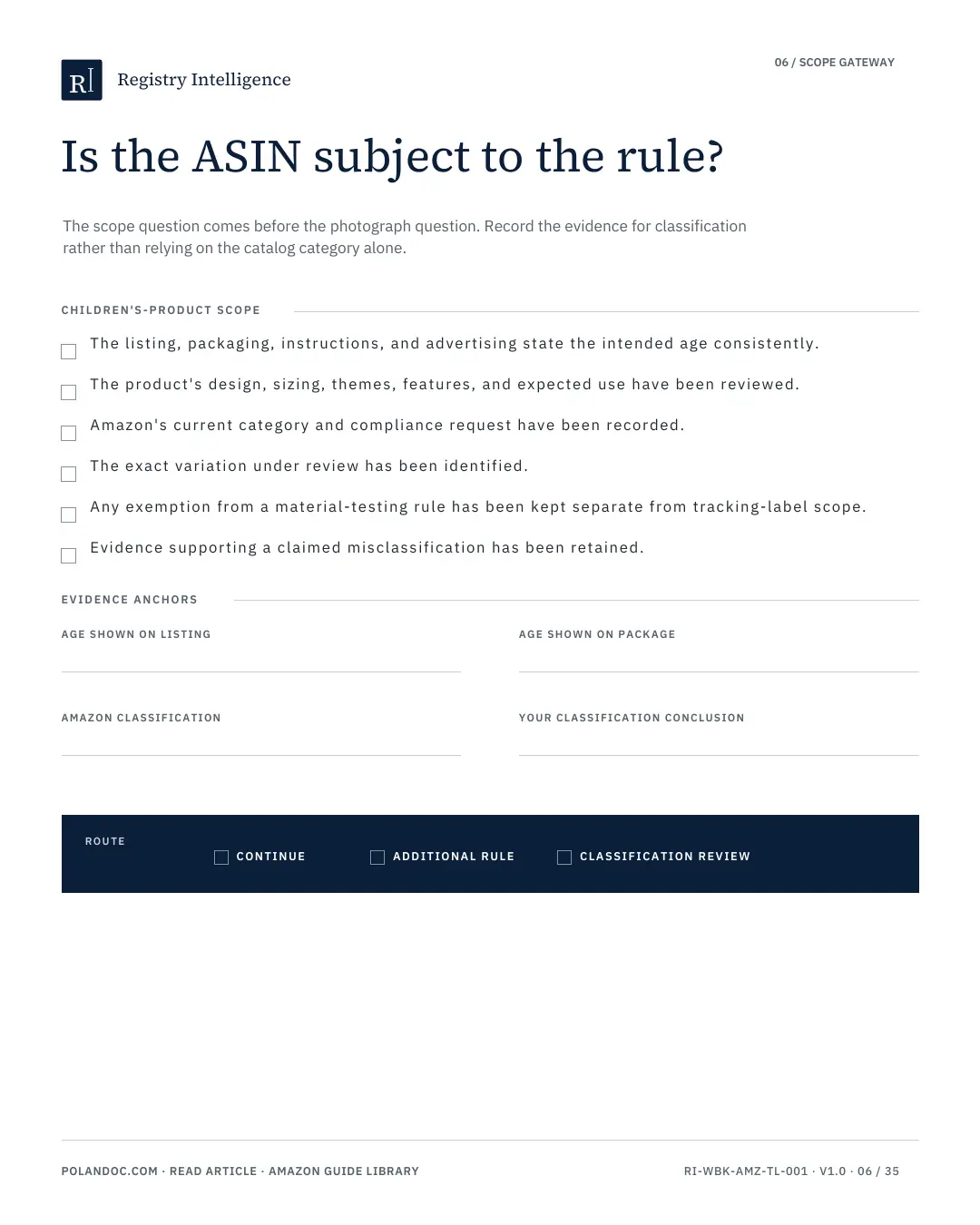
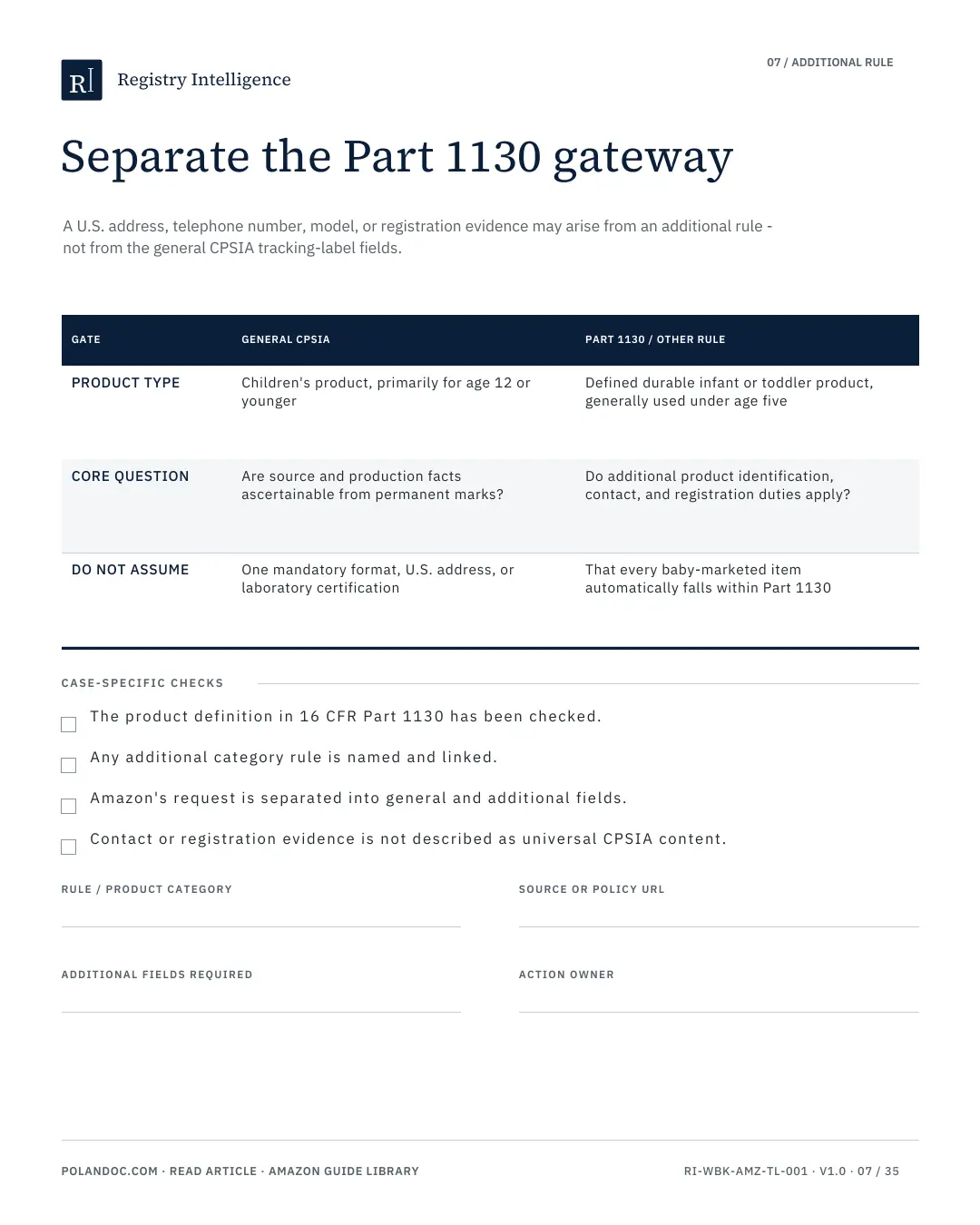
- Case identity, exact rejection preservation, children’s-product scope, and the separate Part 1130 gateway.
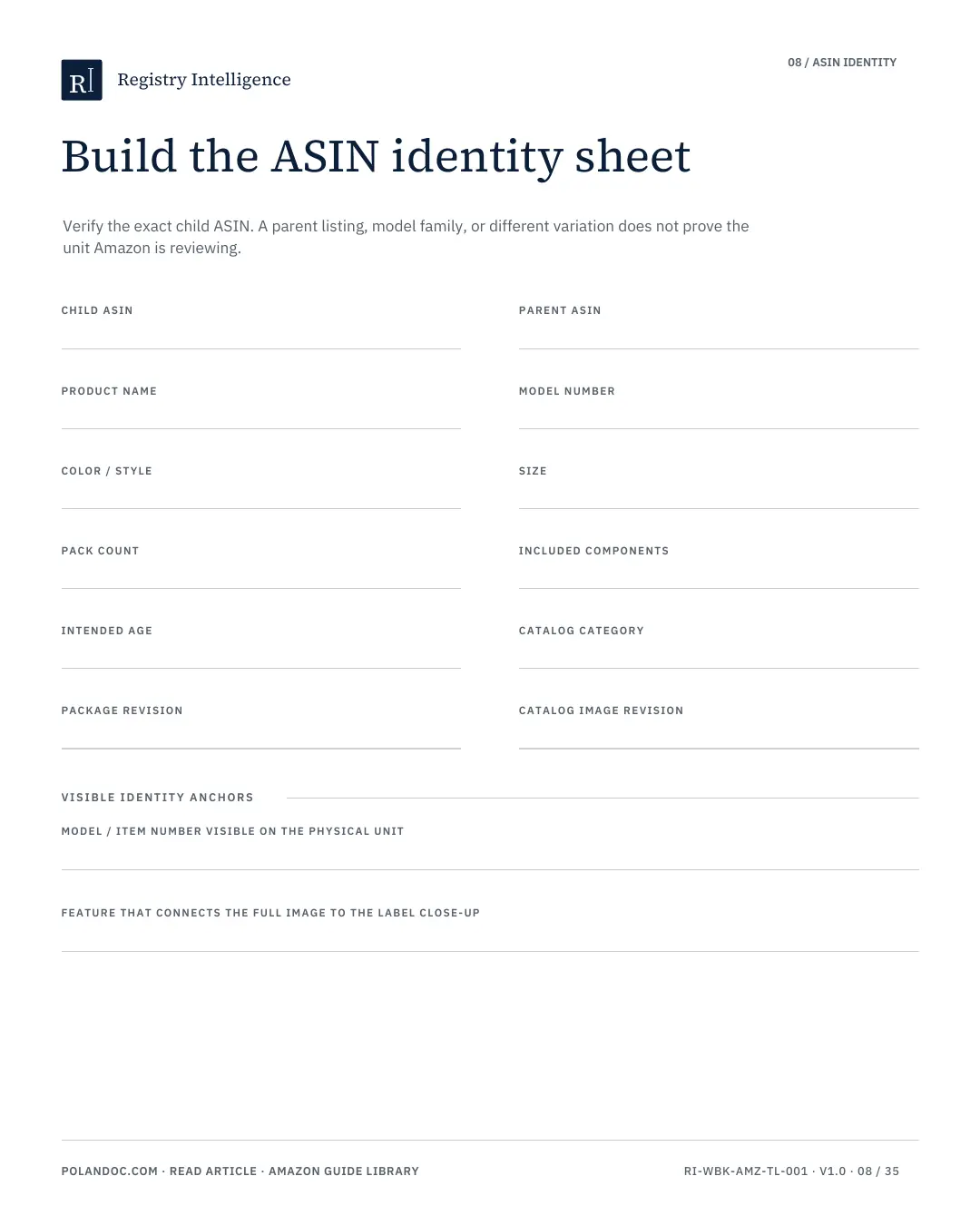
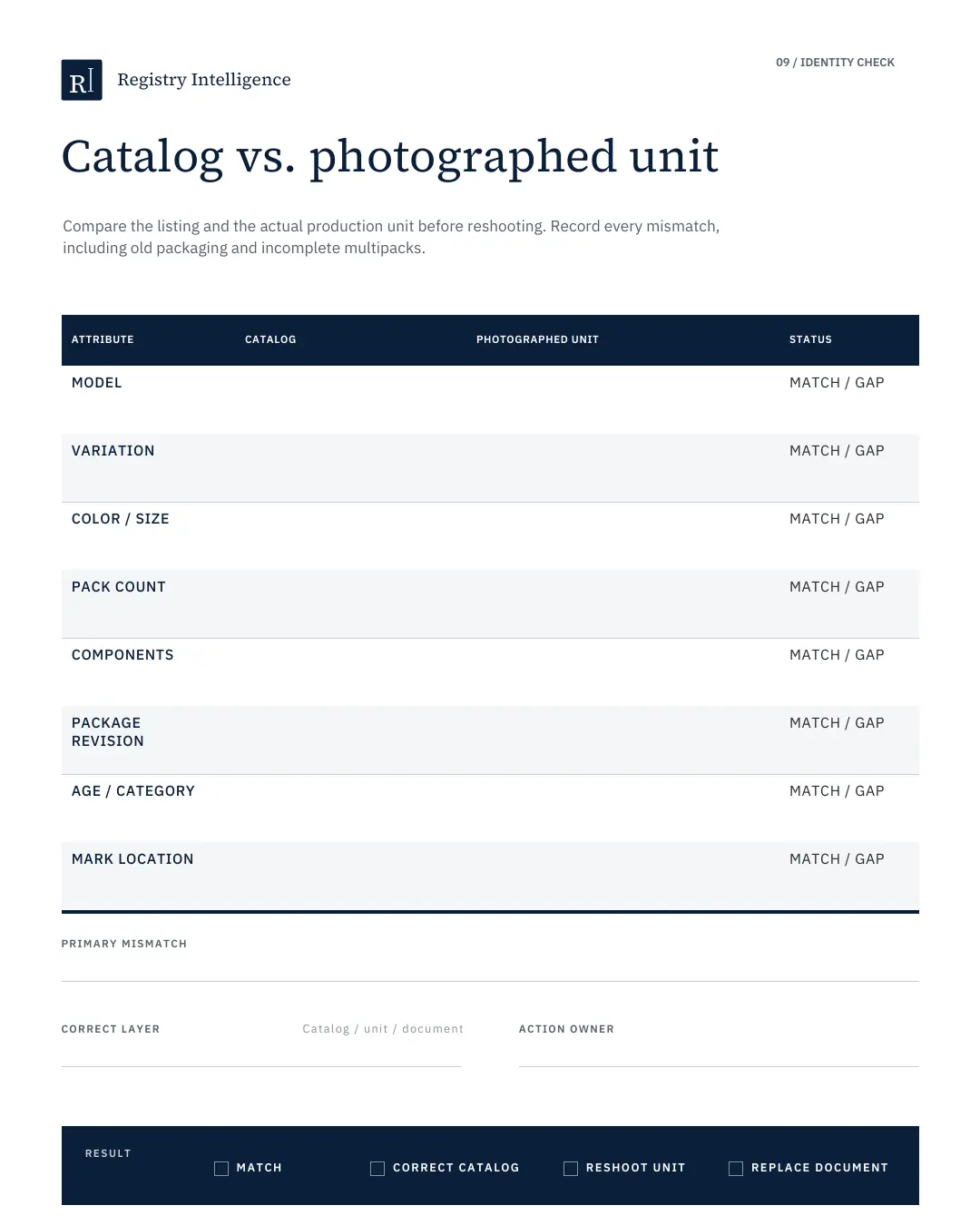
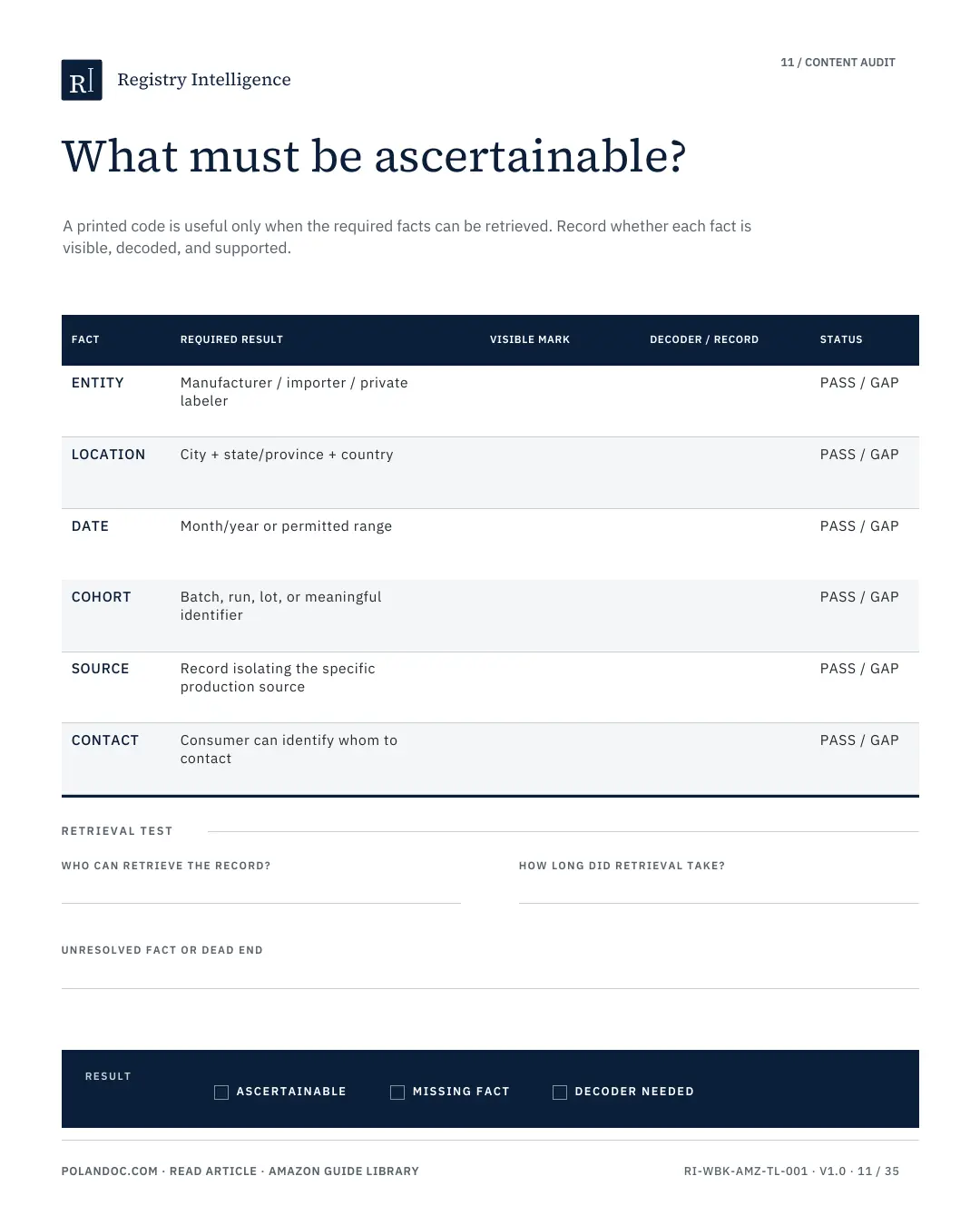
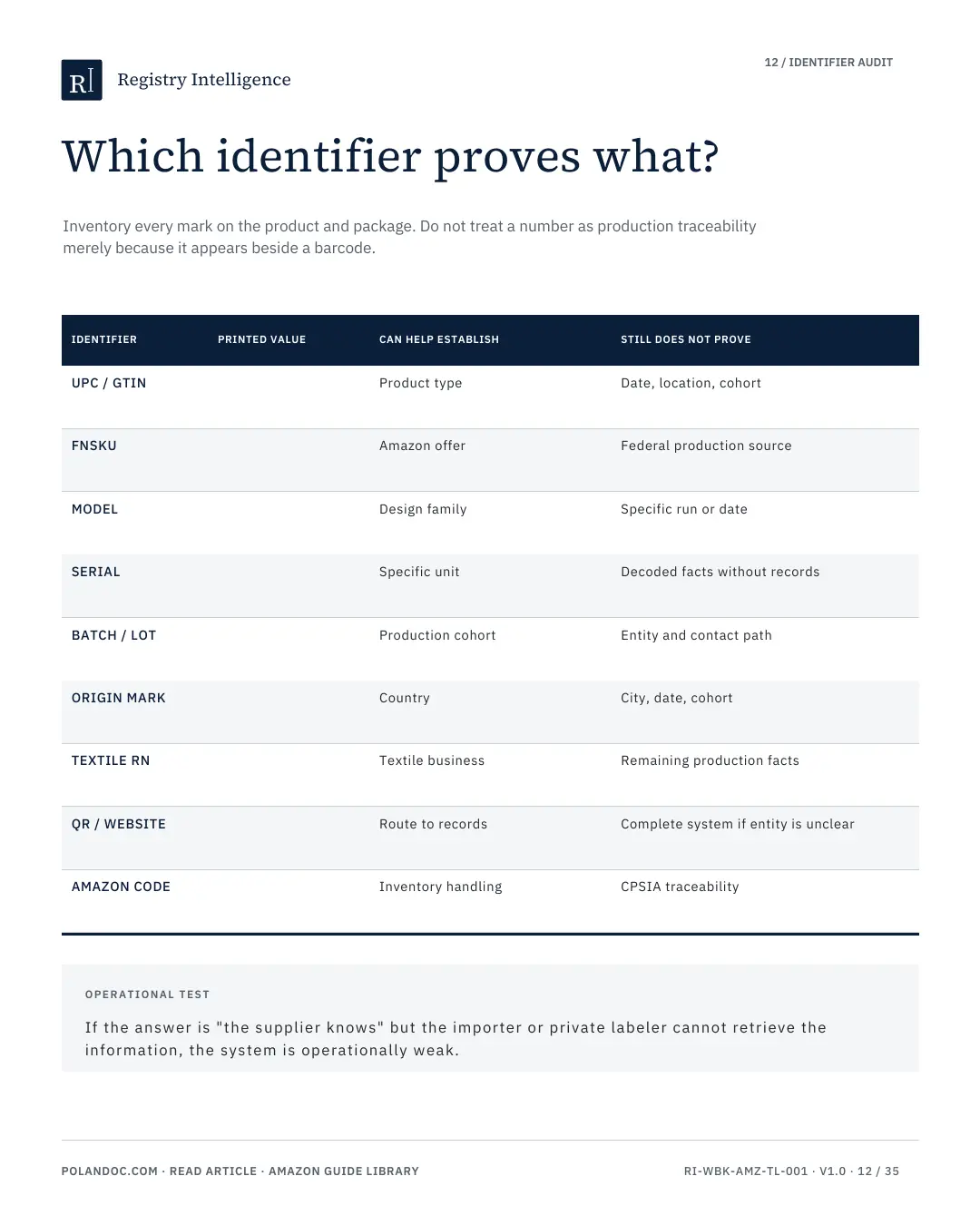
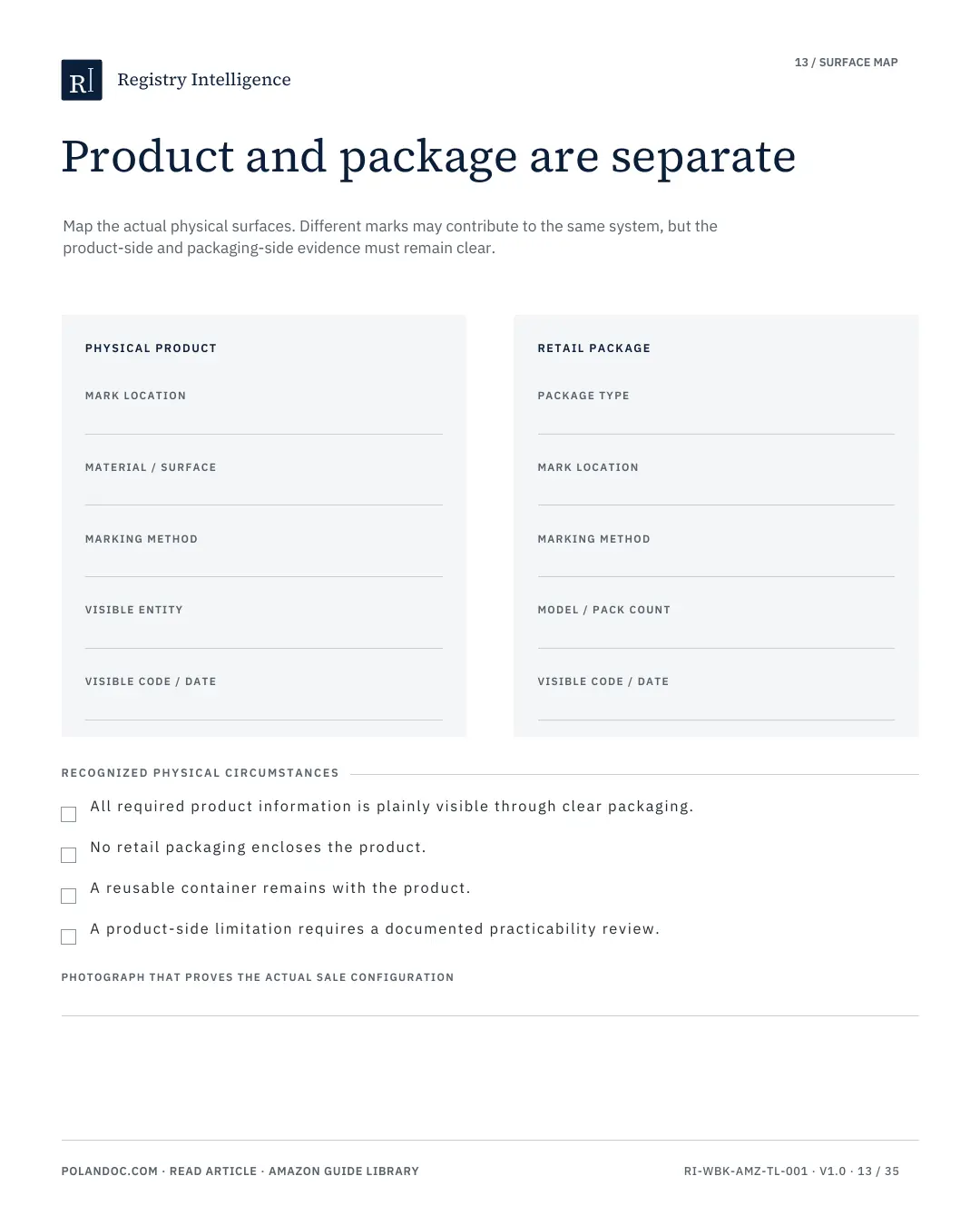
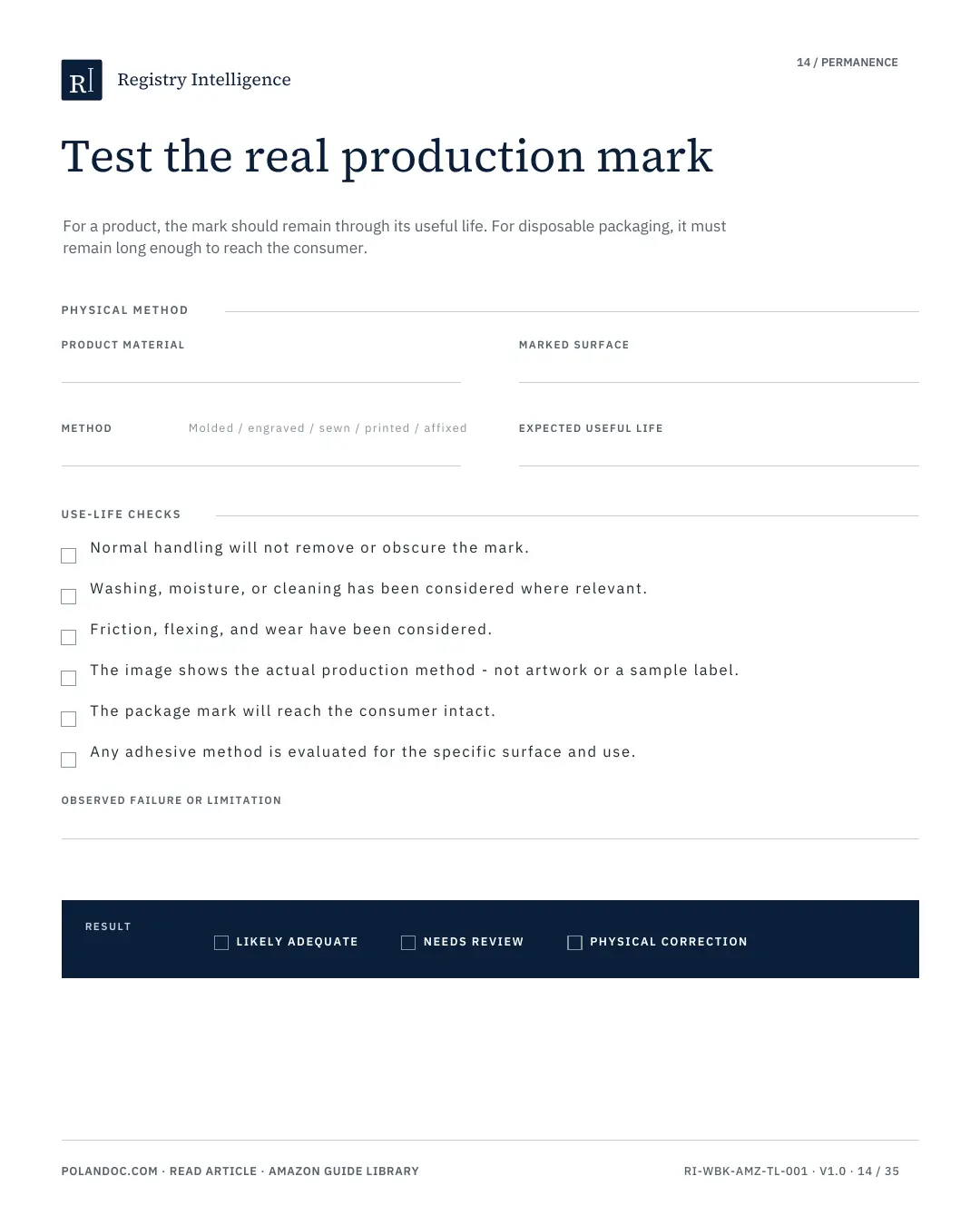
- ASIN-to-unit identity checks, product and package surface mapping, required tracking facts, identifier limits, and permanence.
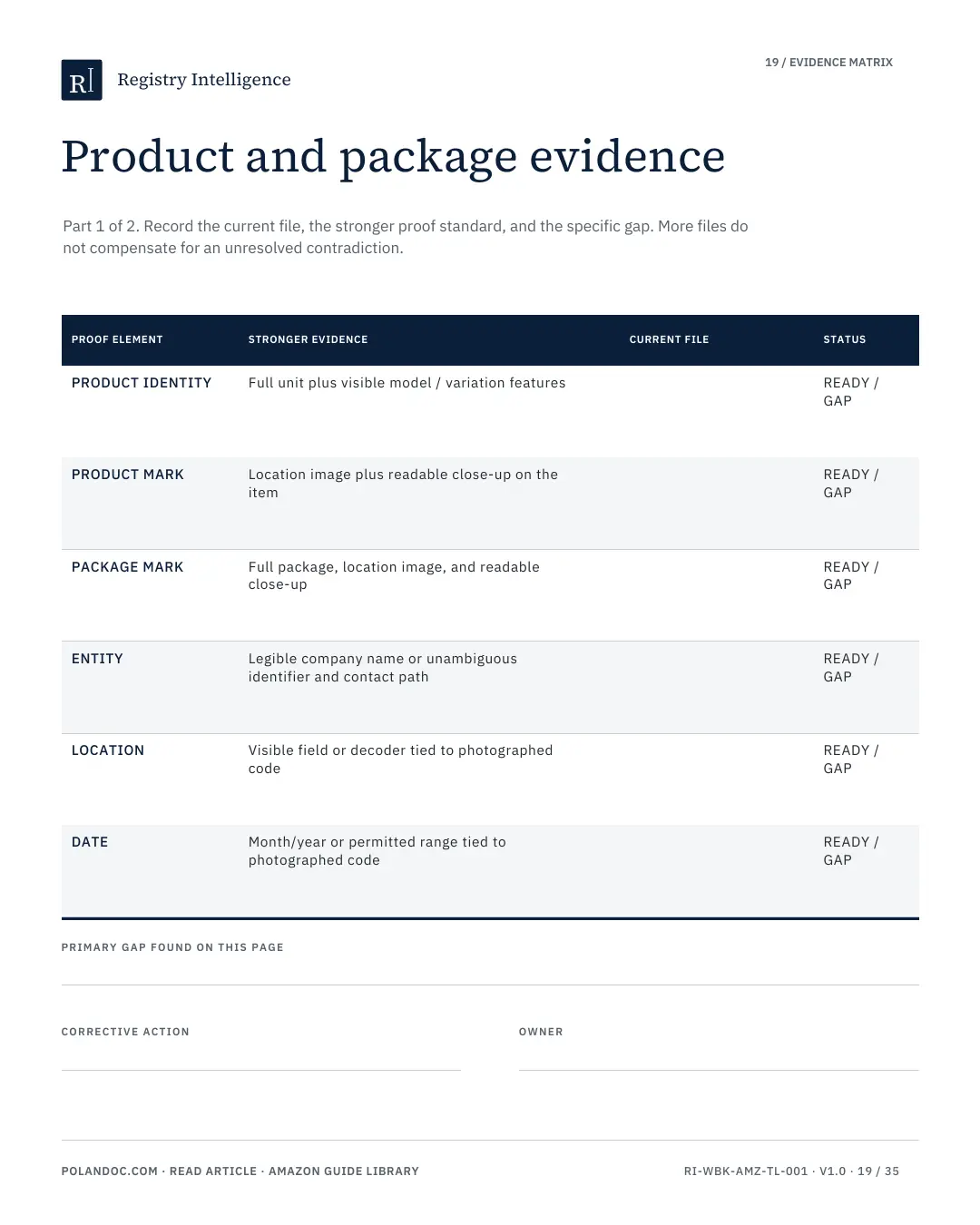
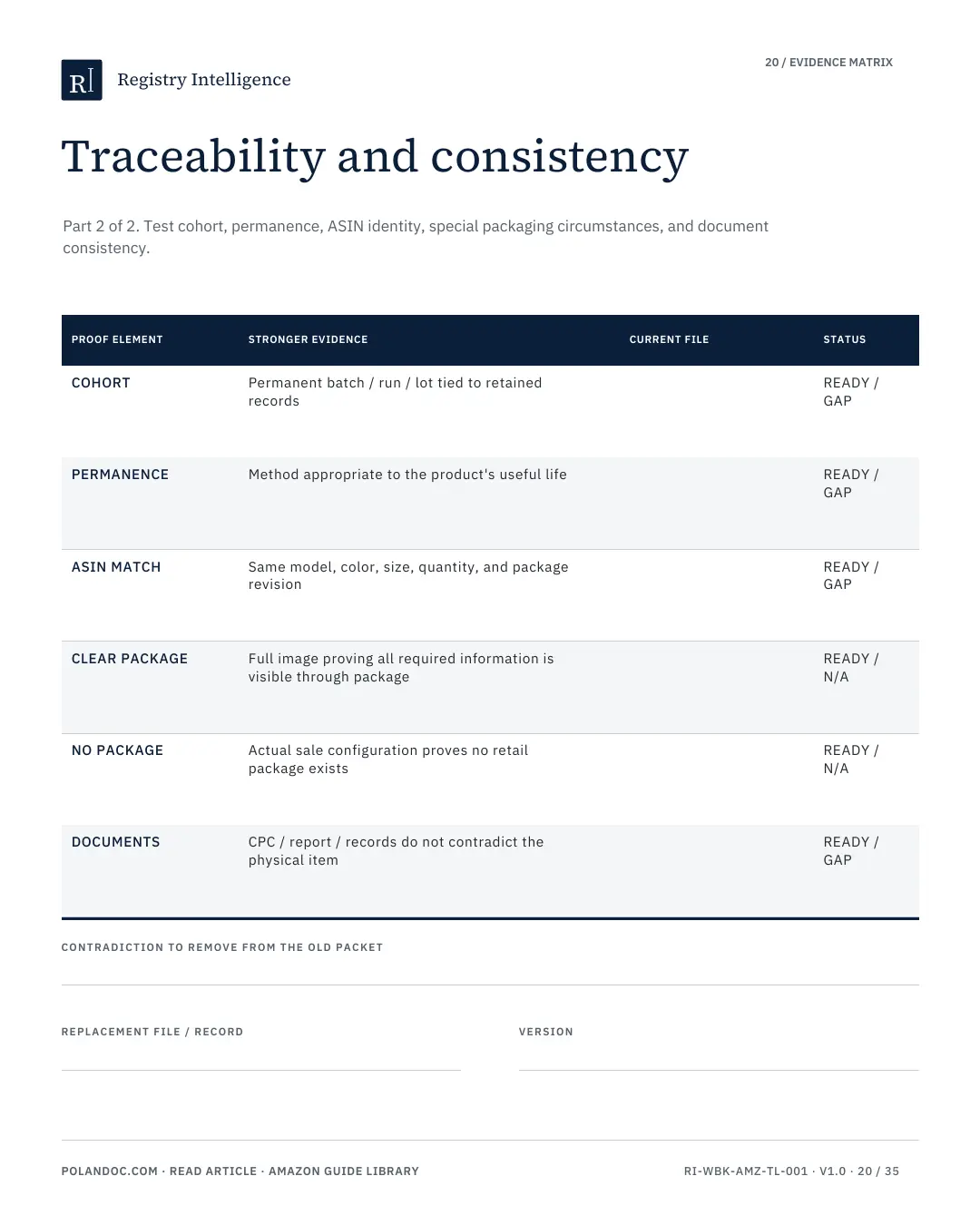
- Practicability records, coded-information decoders, live lookup validation, and product/package evidence matrices.
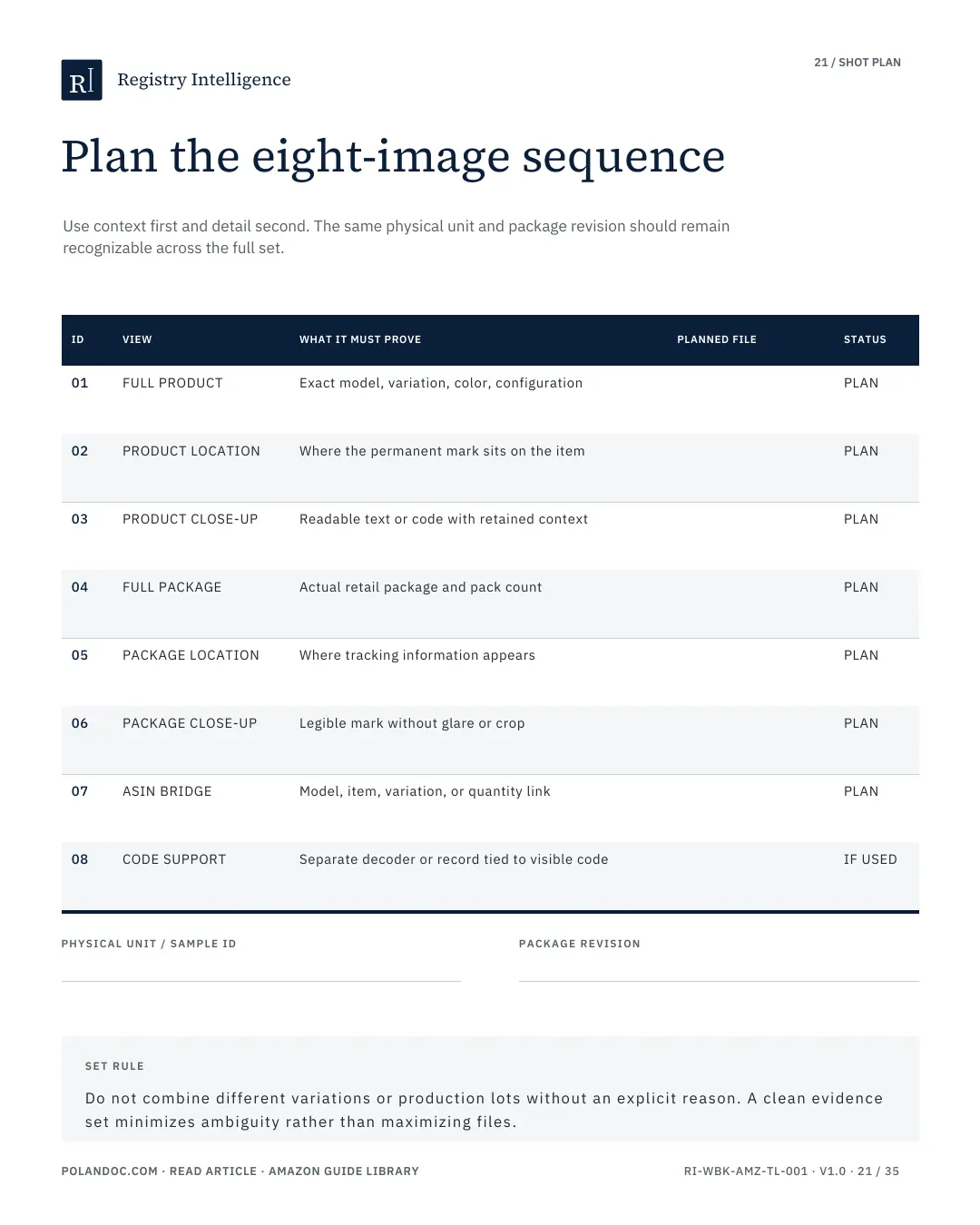
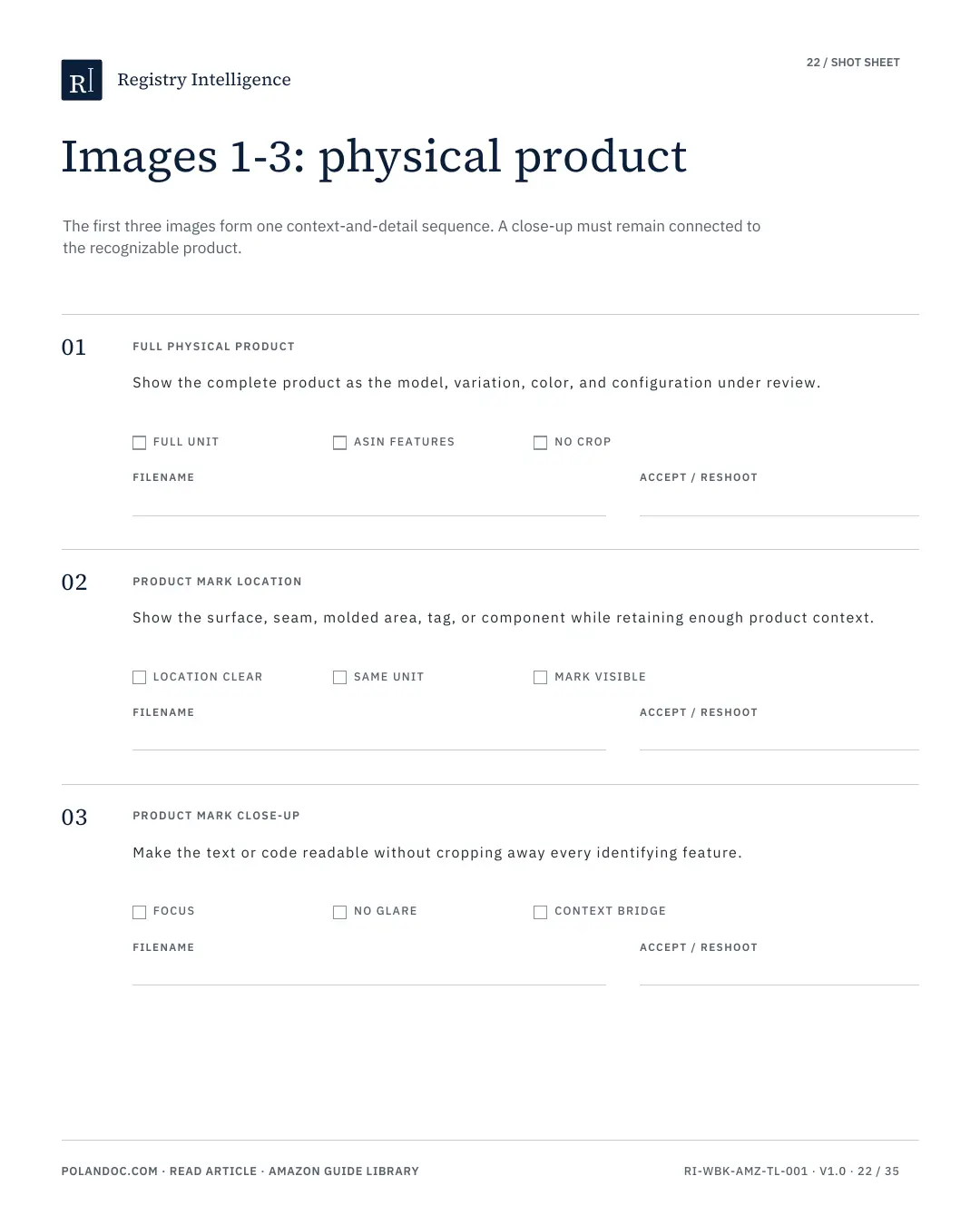
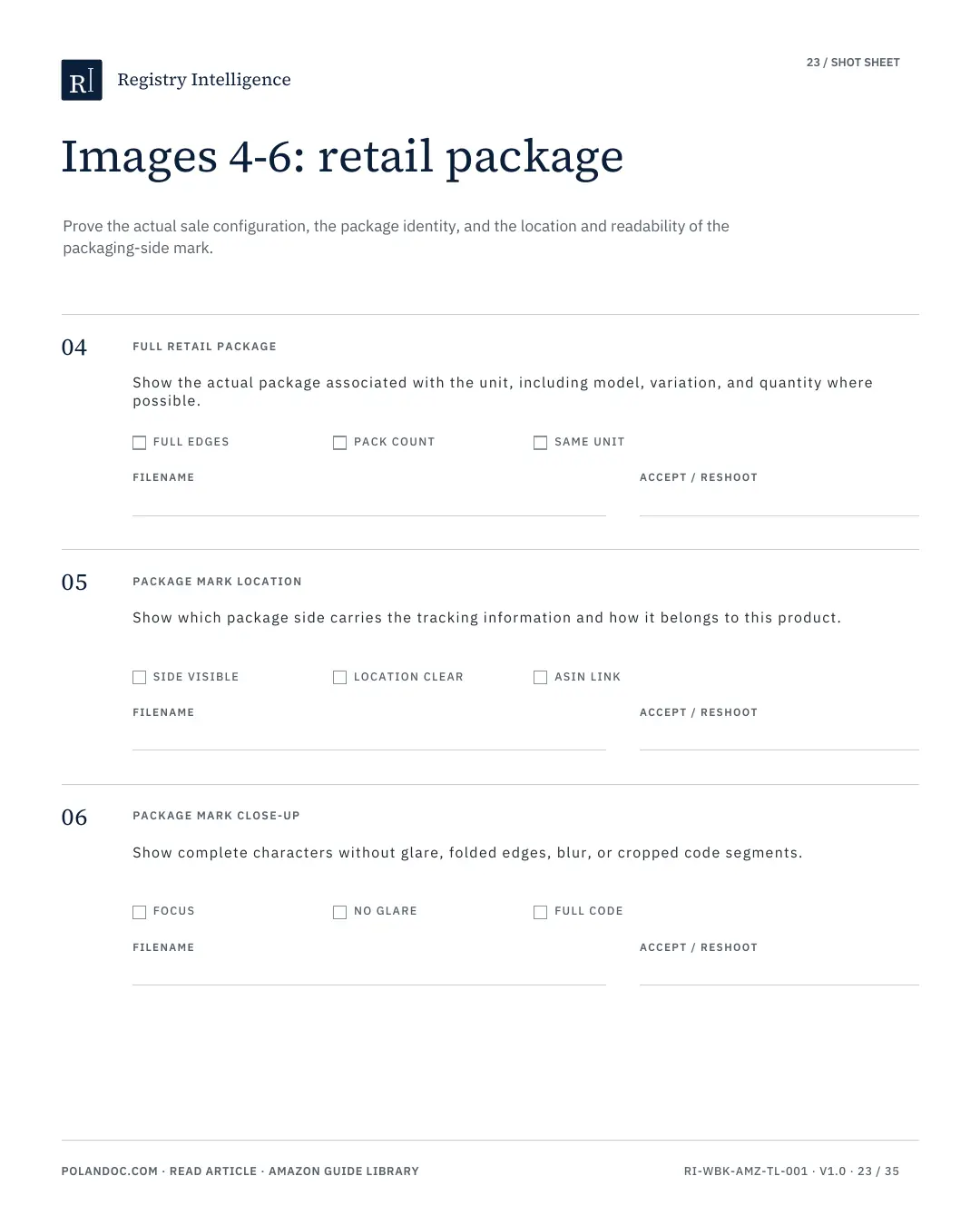
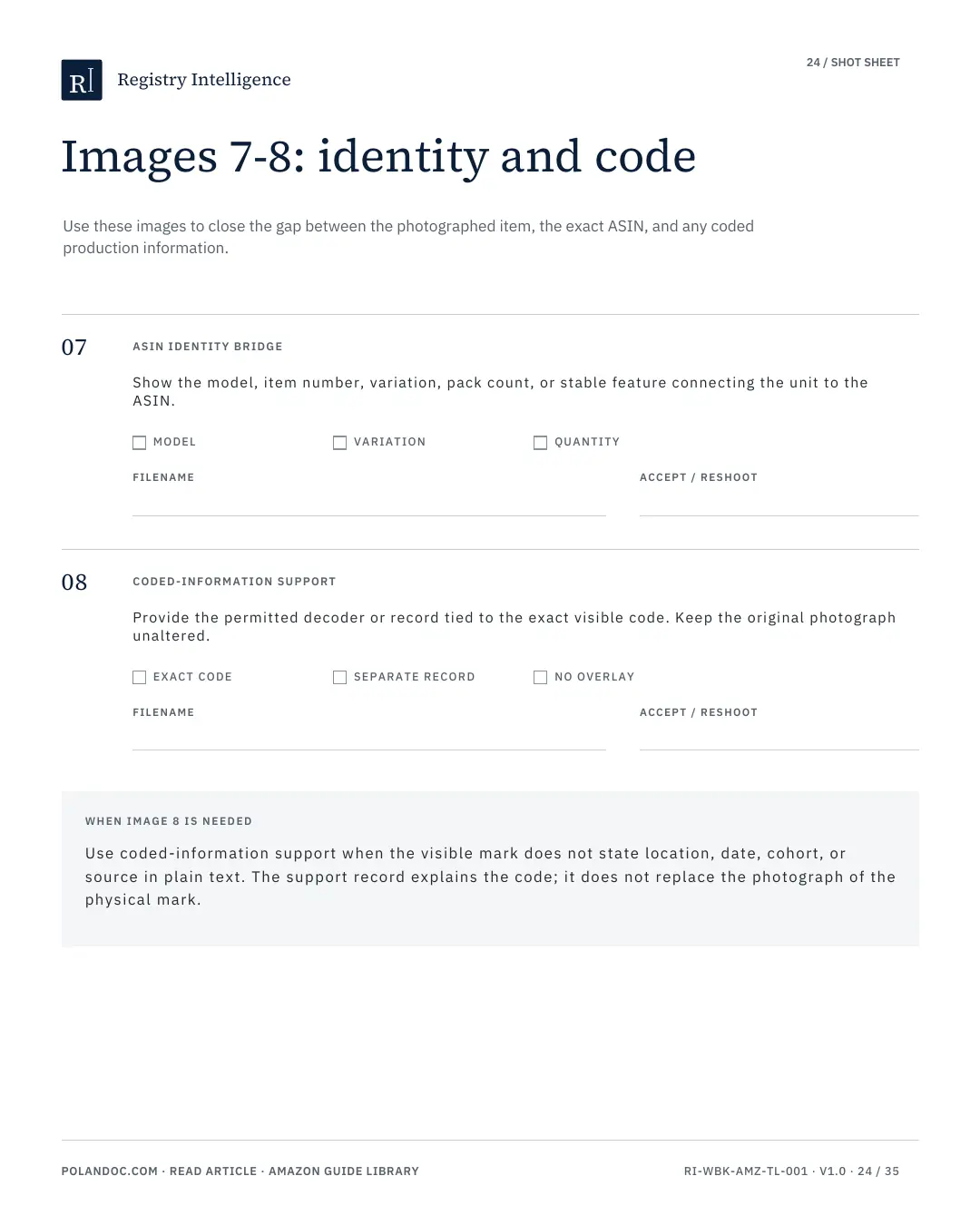
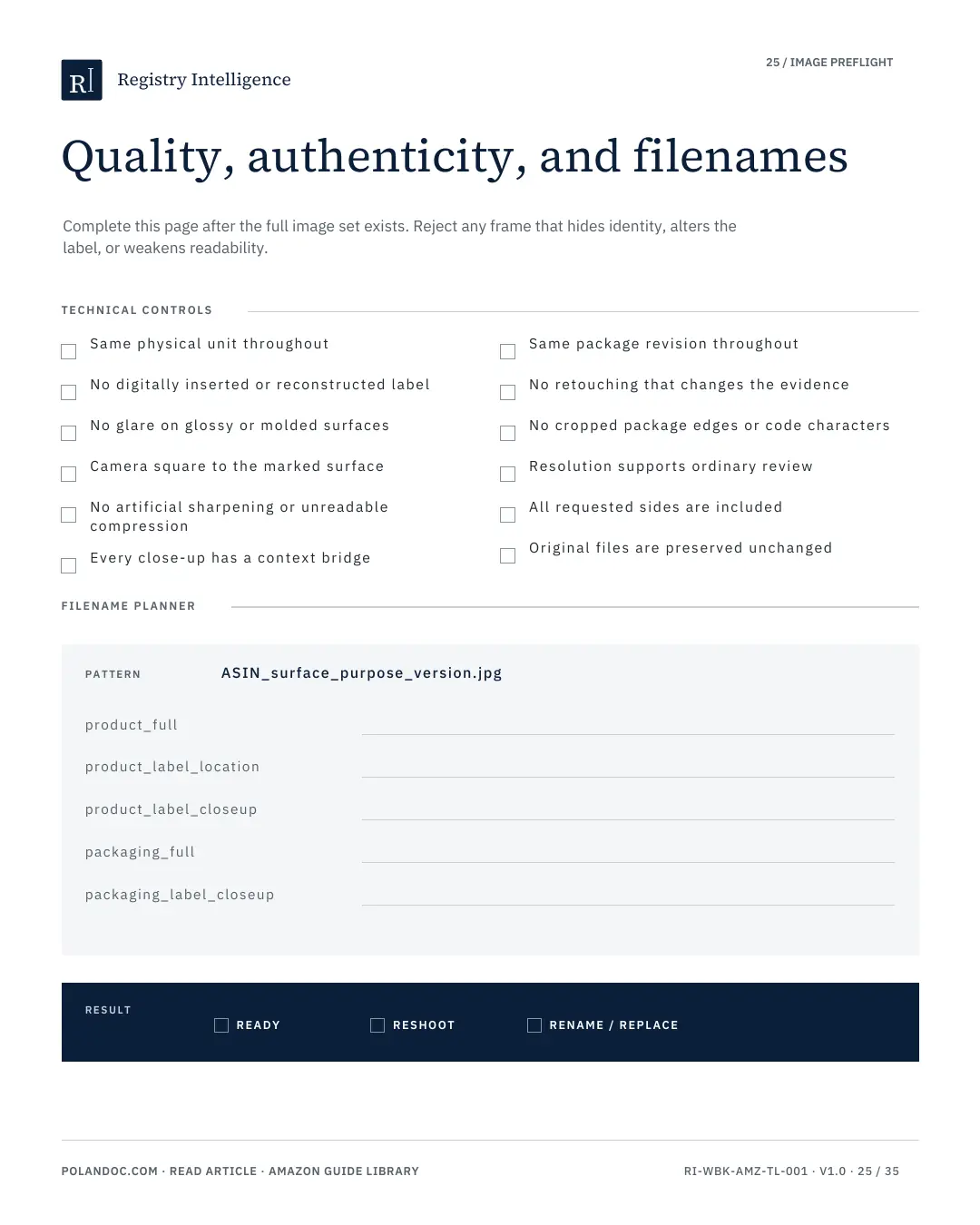
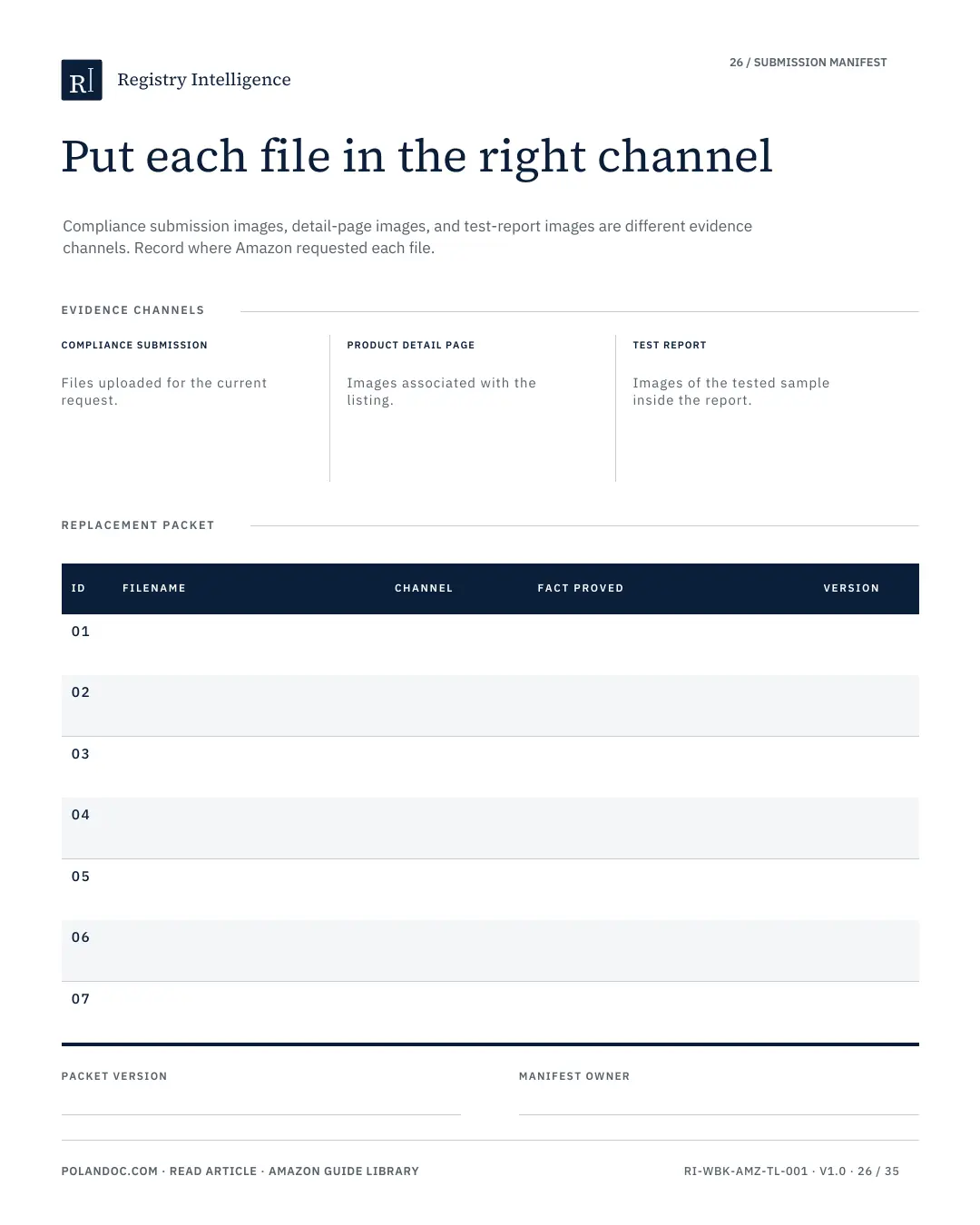
- An eight-image context-and-detail shot plan, technical preflight, filenames, evidence channels, and submission manifest.
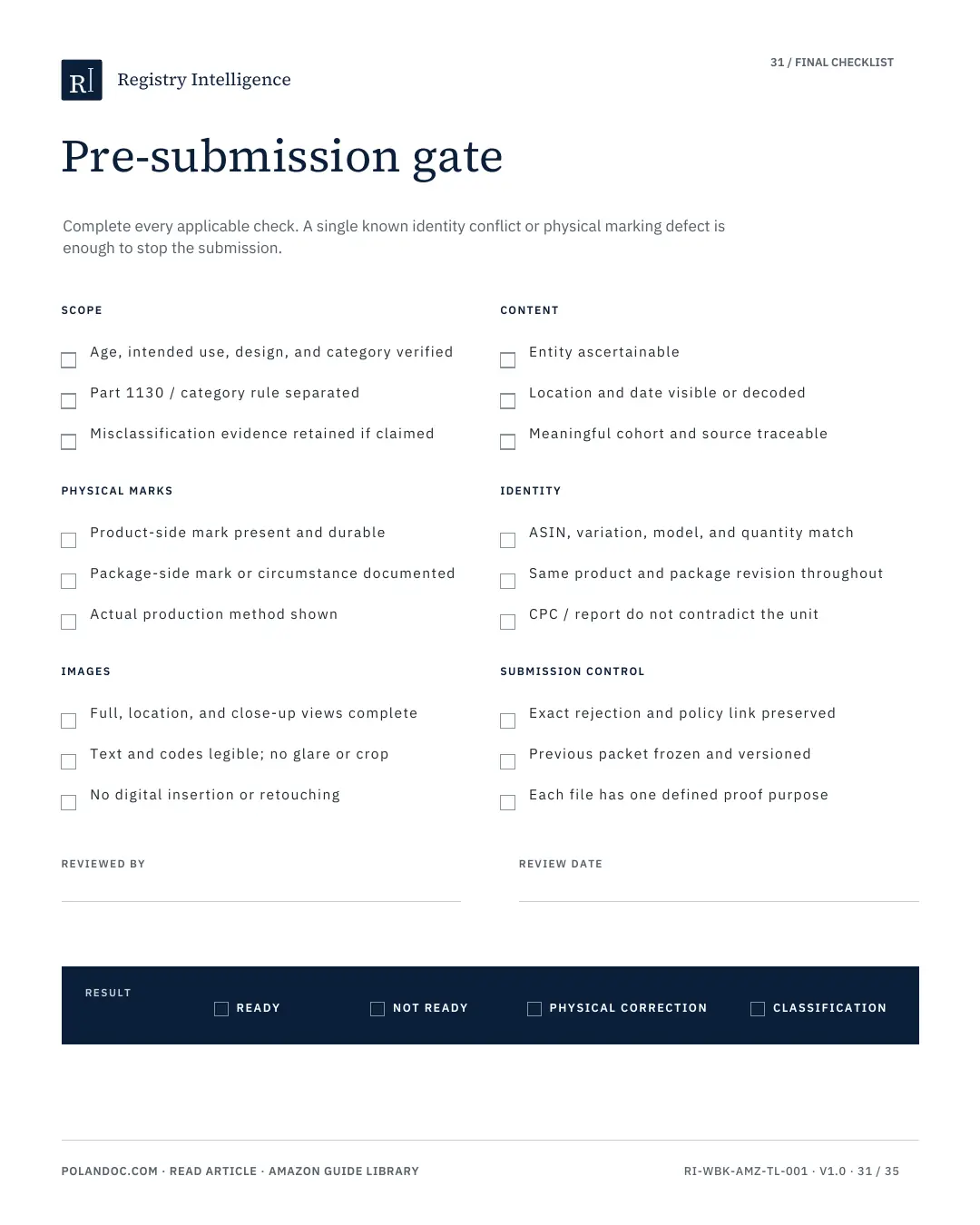
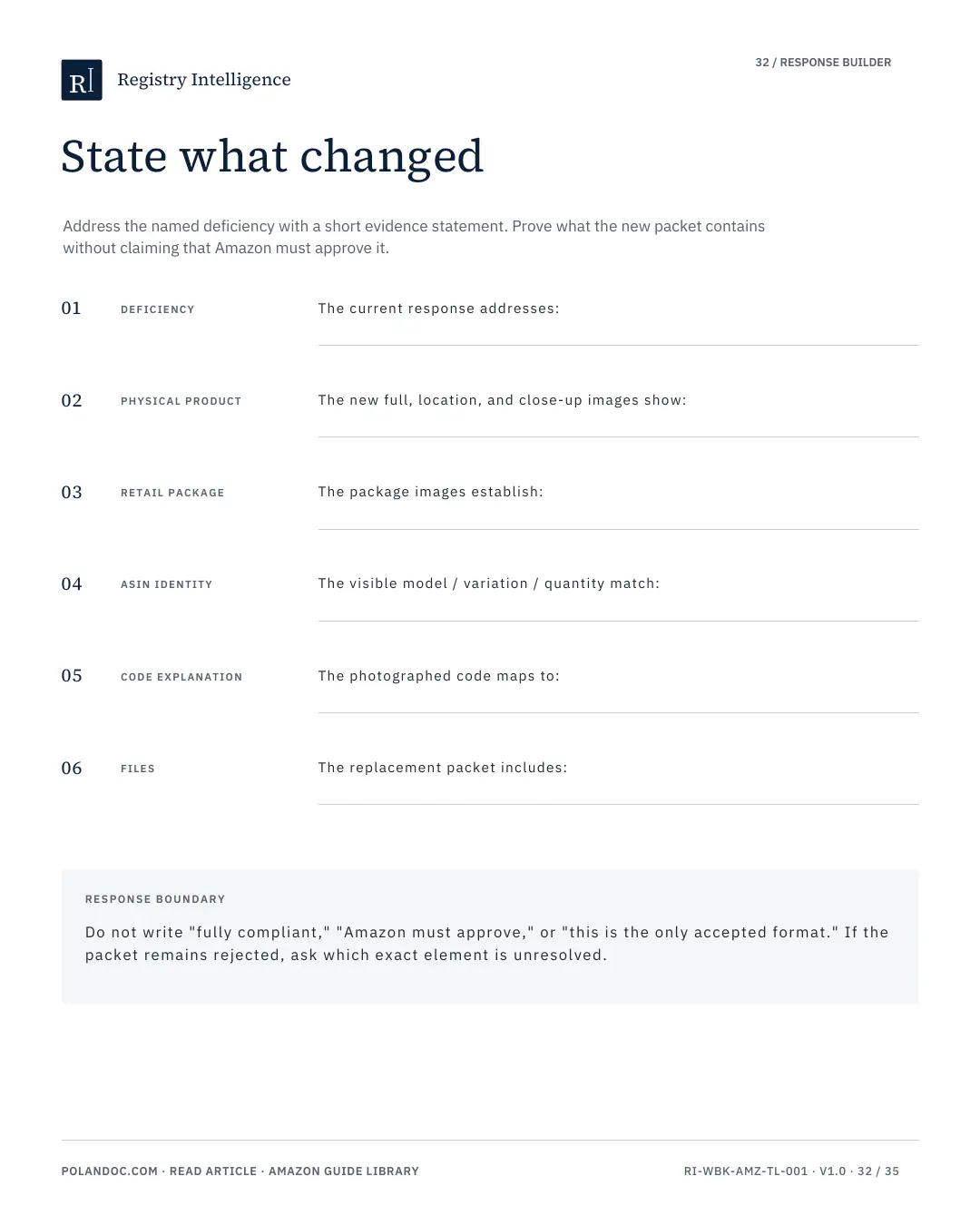
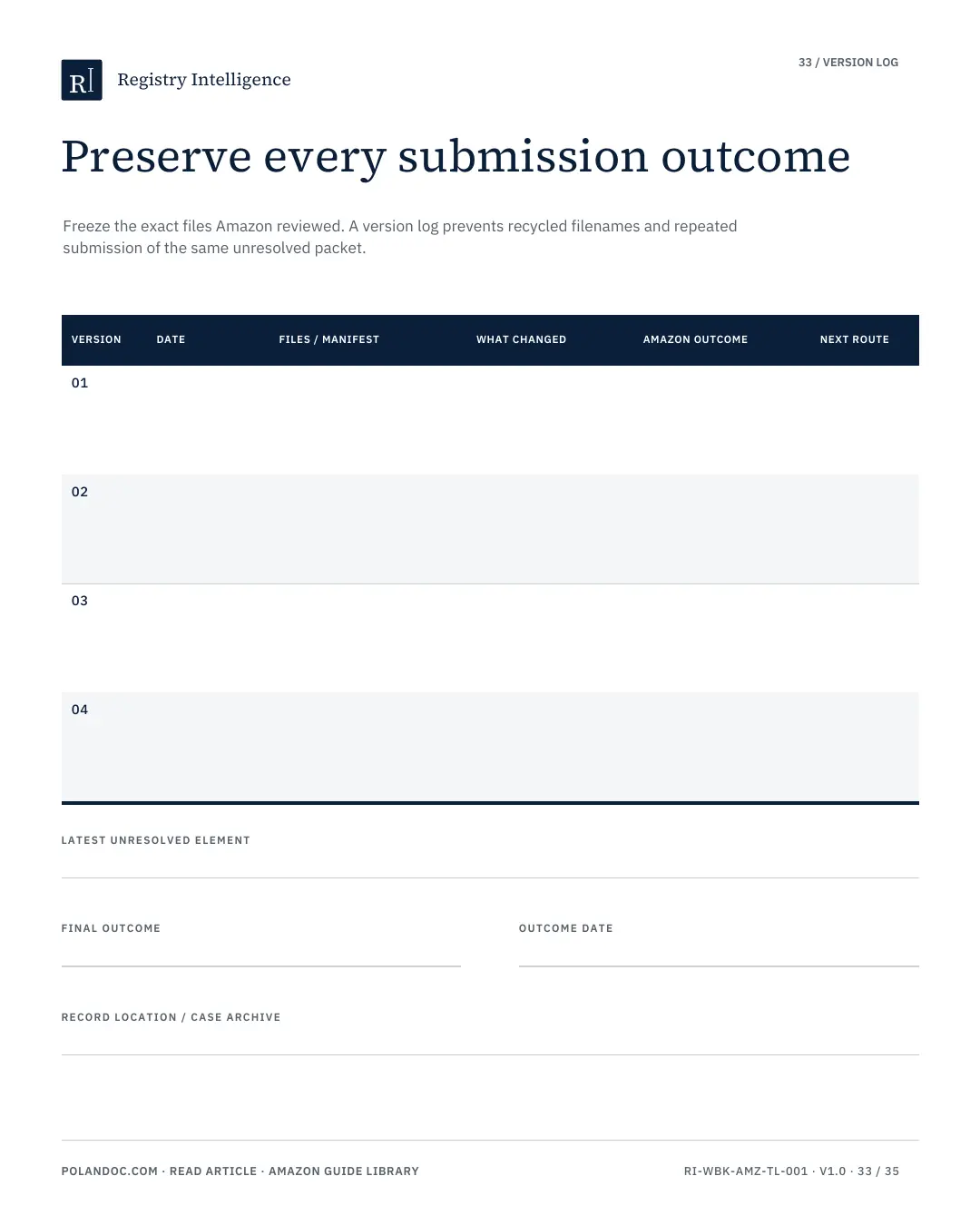
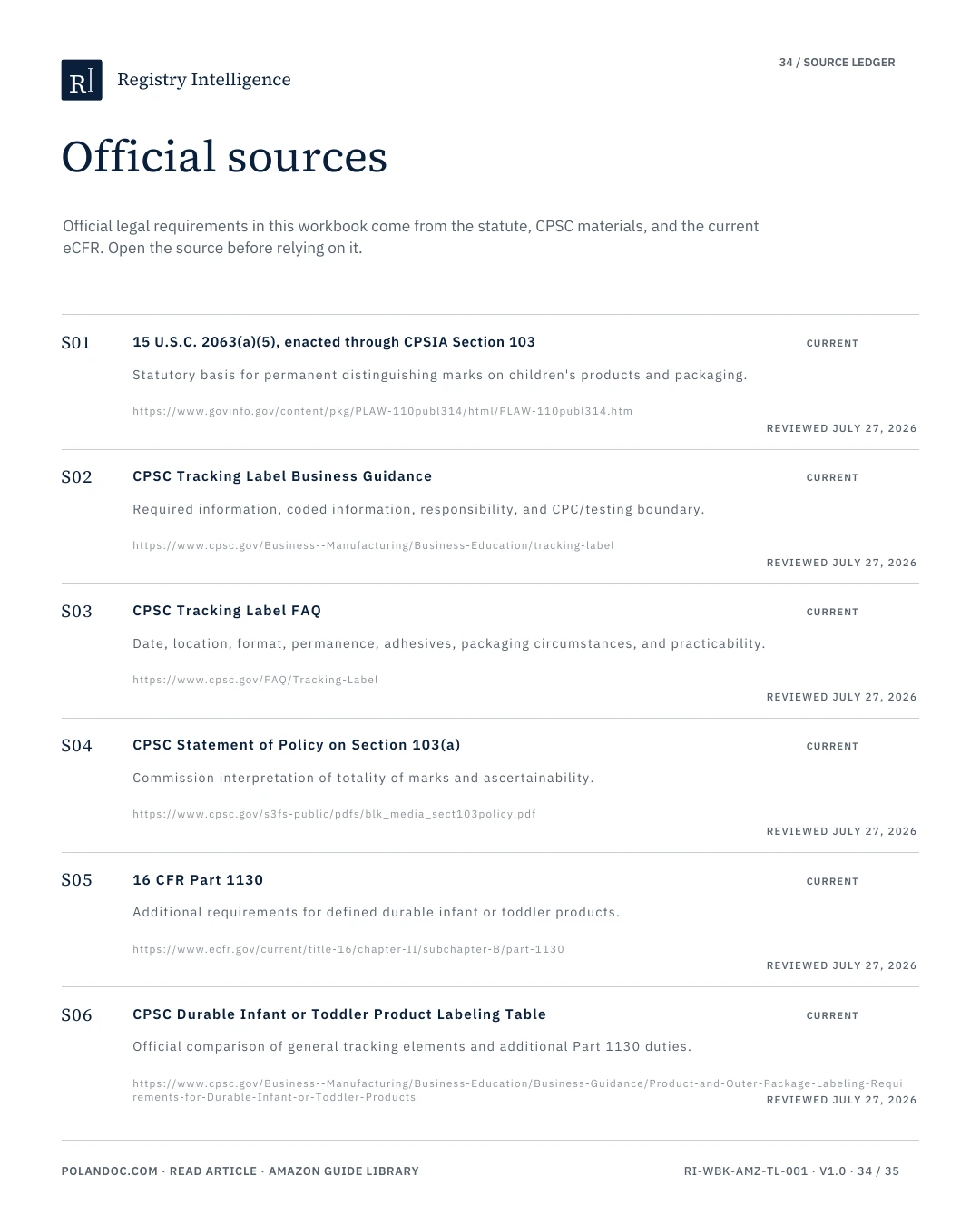
- Rejection decoding, route selection, corrective action planning, final readiness gate, response builder, version log, and source ledgers.
Format35-page PDF
AudienceU.S. Amazon sellers reviewing tracking-label image evidence
Reviewed
Viewer page images
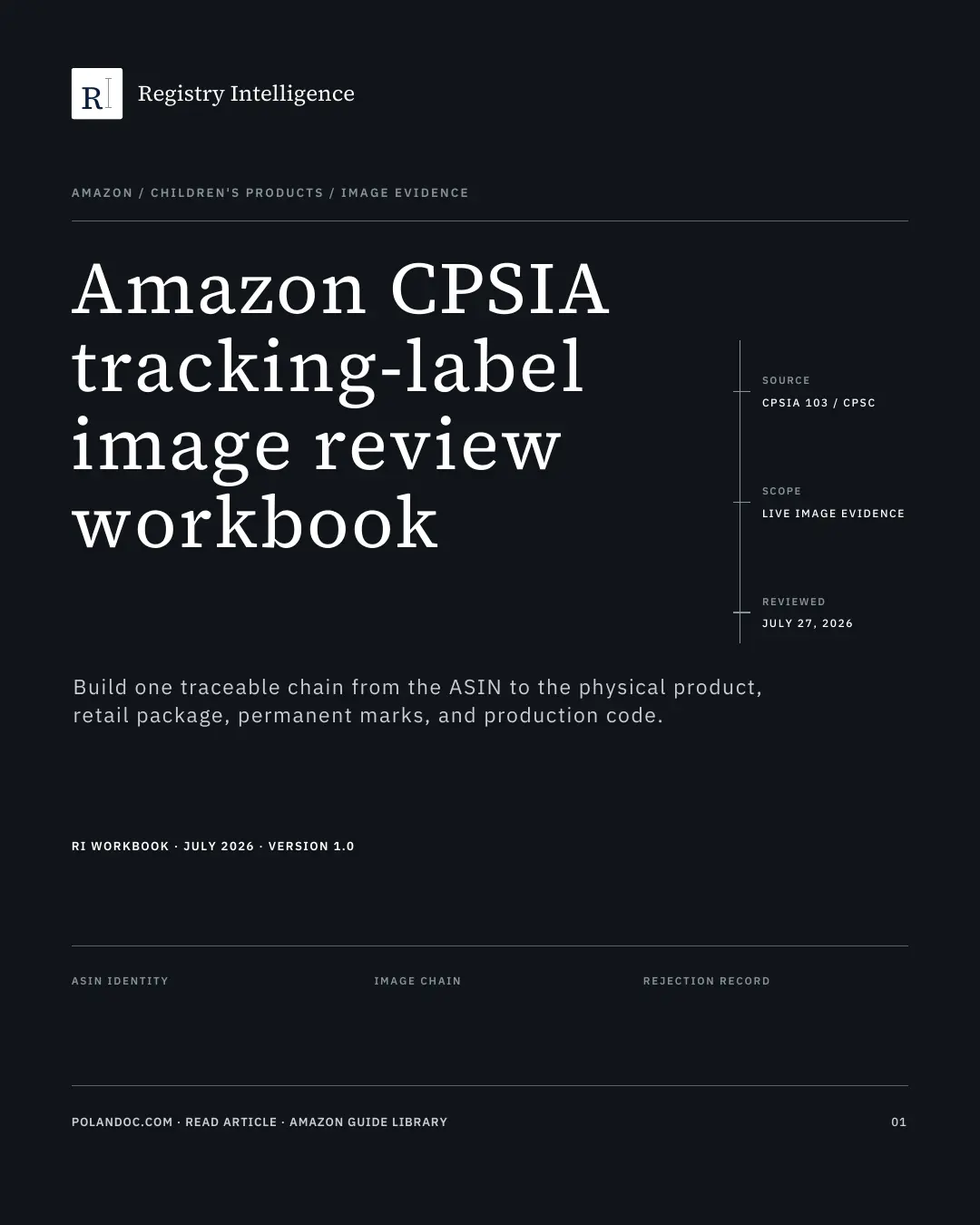
- Cover: Amazon CPSIA Tracking-Label Image Review Workbook
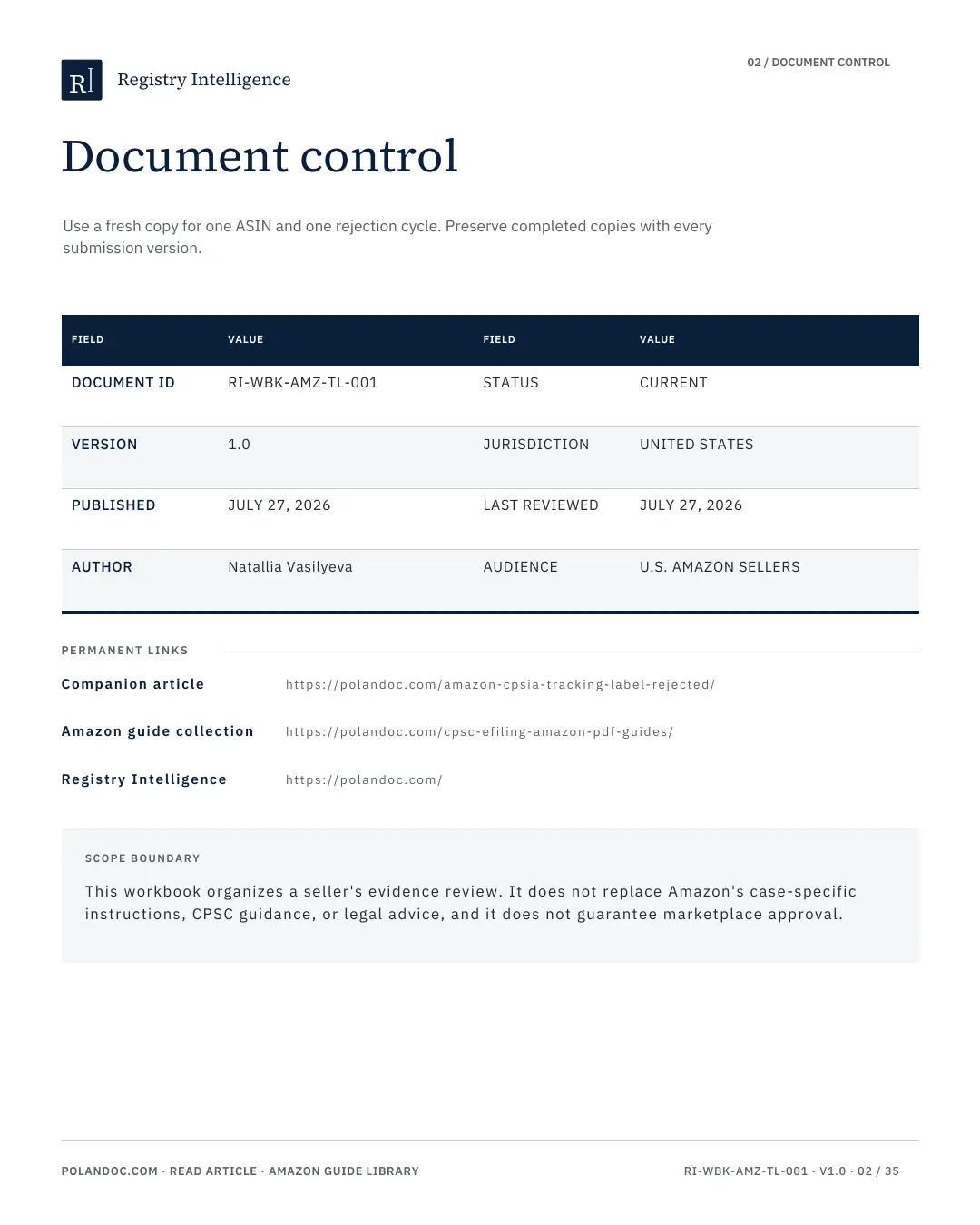
- Document control
- Use the shortest defensible route
- Case identity sheet
- Preserve the exact rejection
- Is the ASIN subject to the rule?
- Separate the Part 1130 gateway
- Build the ASIN identity sheet
- Catalog vs. photographed unit
- Test every link in the chain
- What must be ascertainable?
- Which identifier proves what?
- Product and package are separate
- Test the real production mark
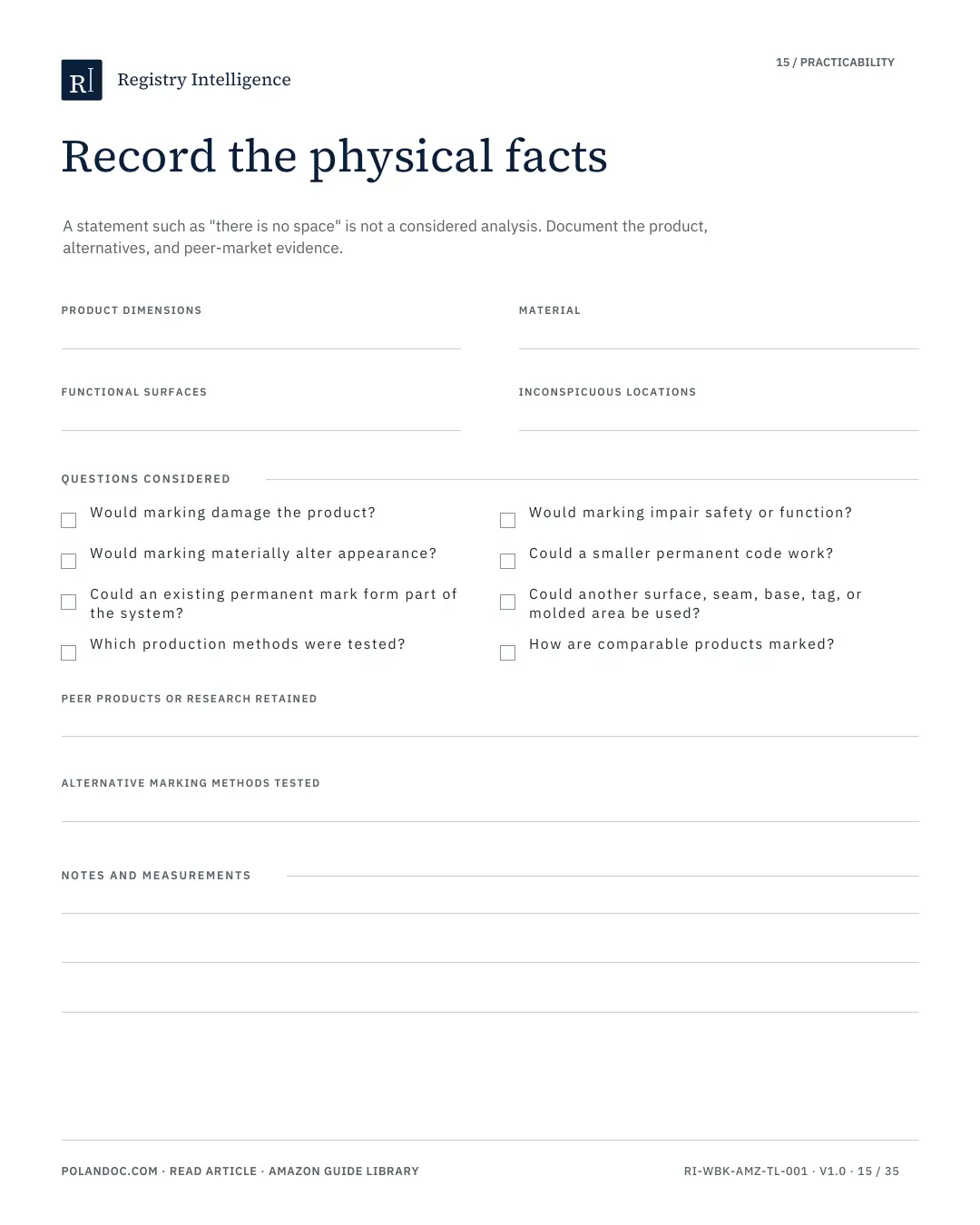
- Record the physical facts
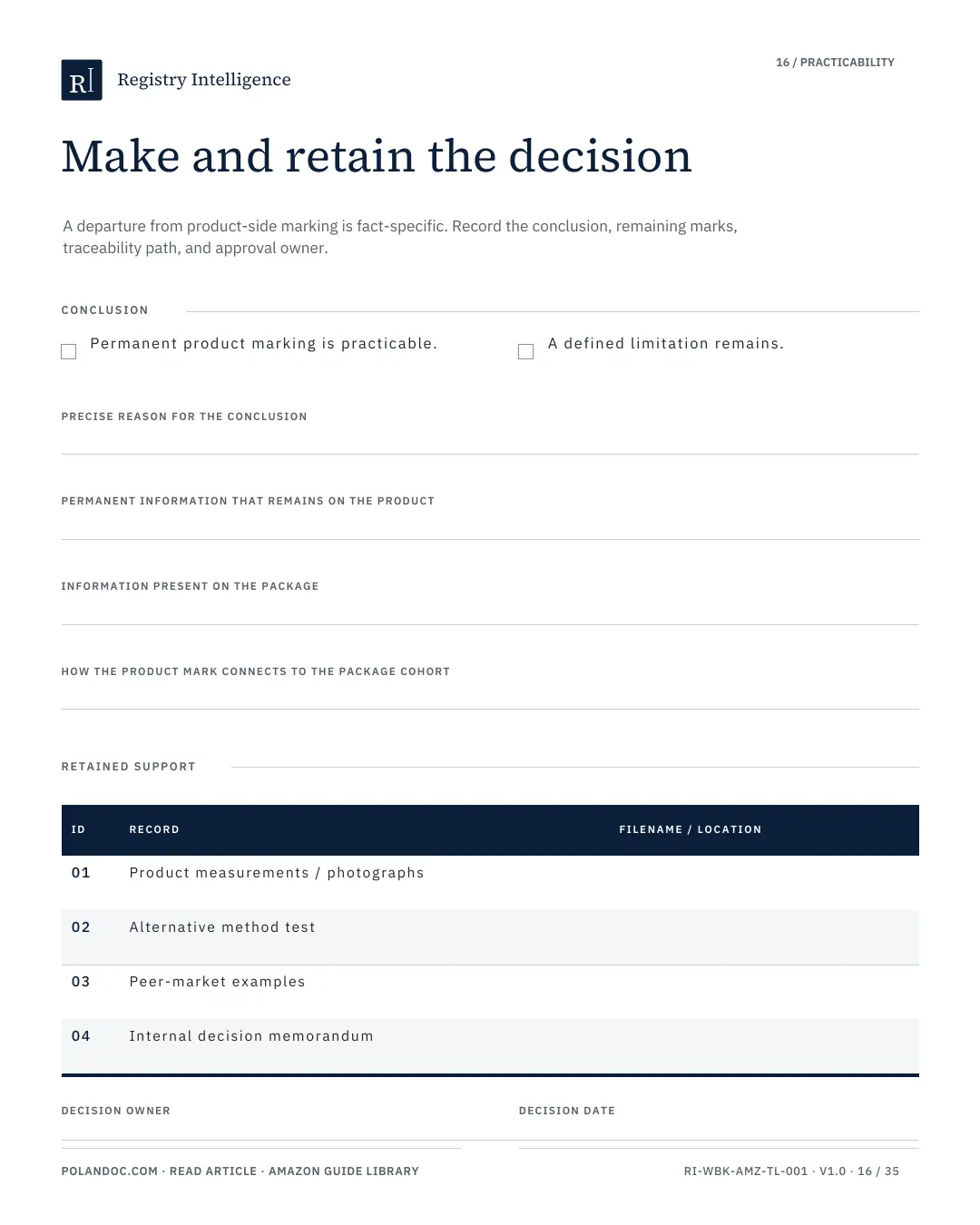
- Make and retain the decision
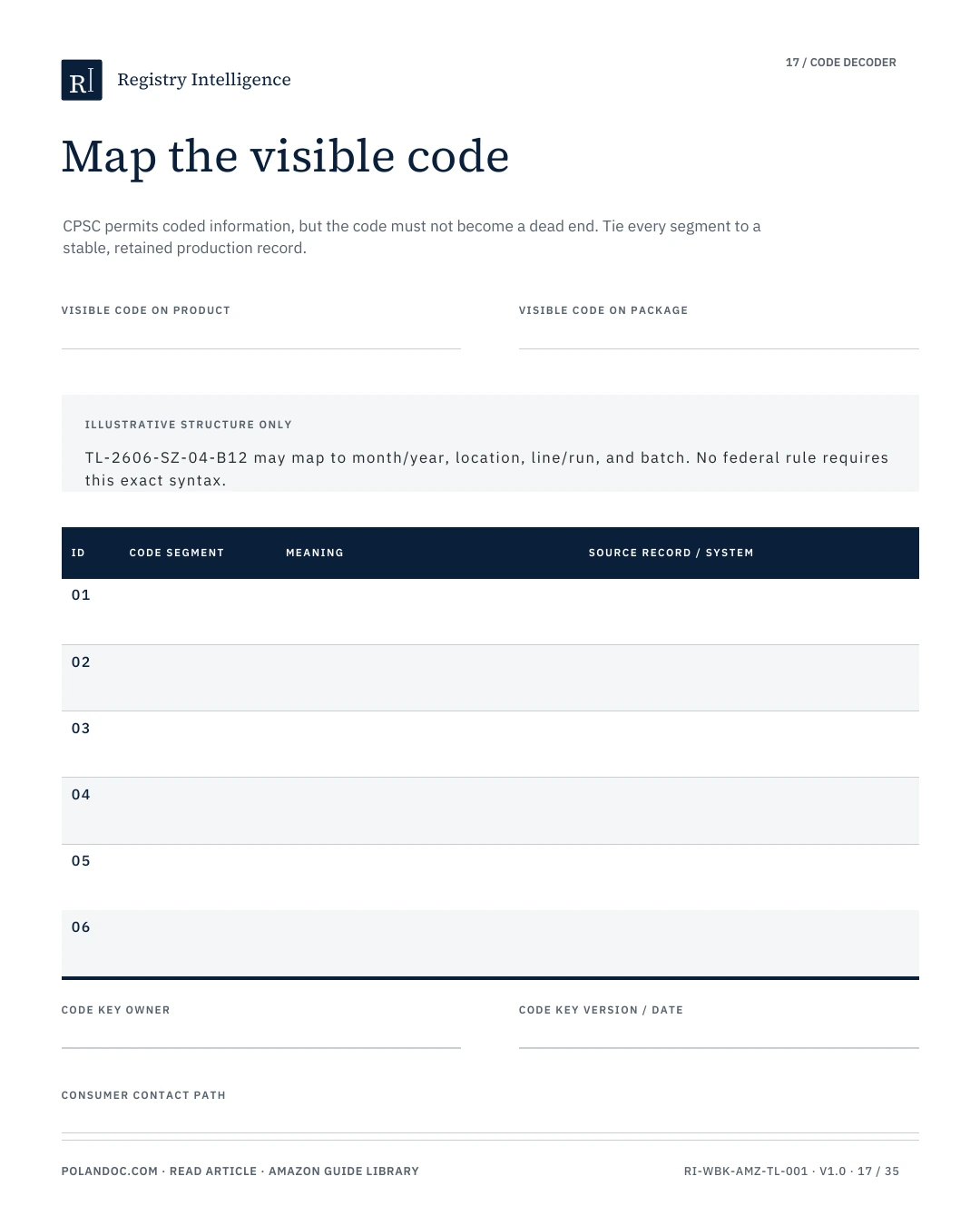
- Map the visible code
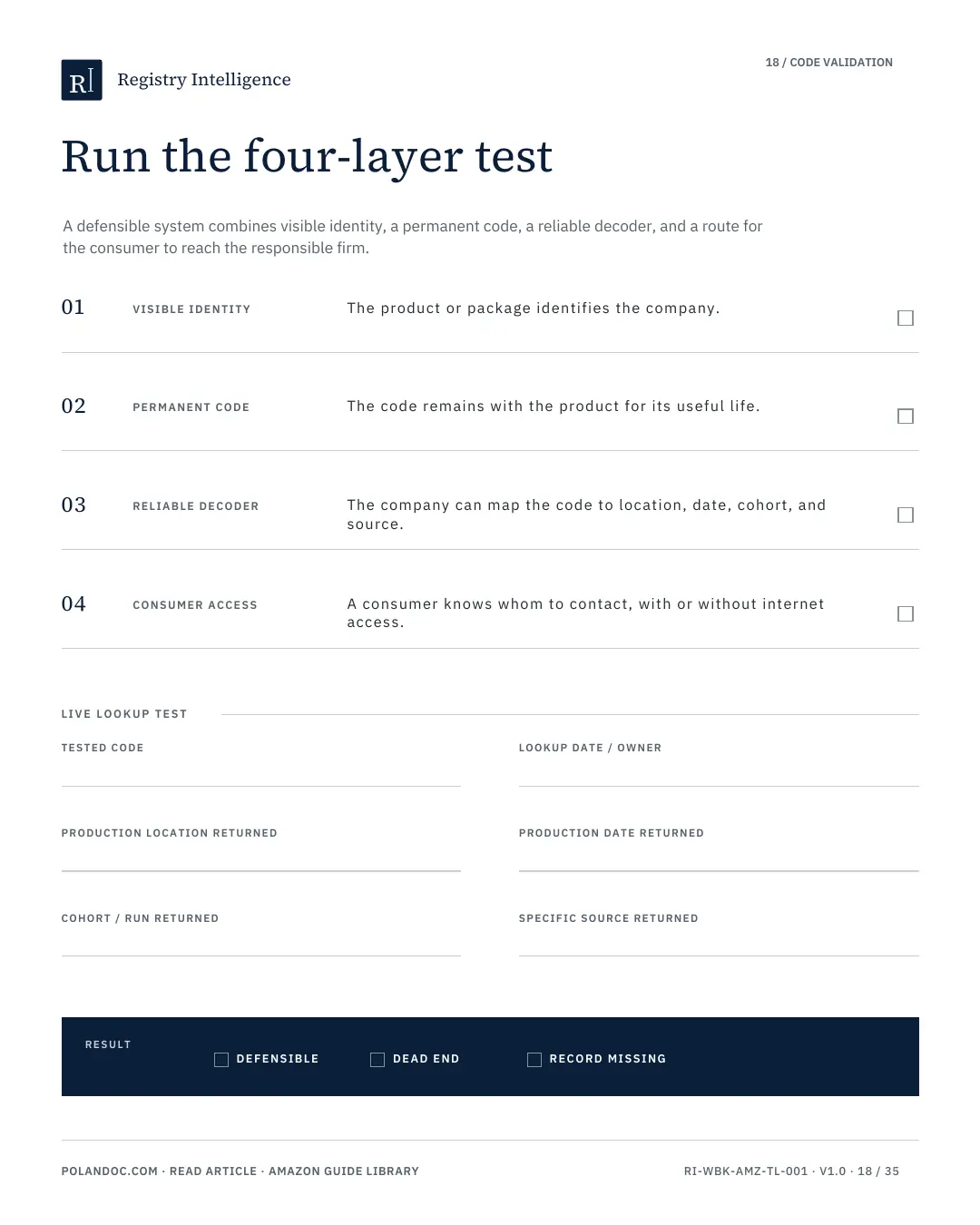
- Run the four-layer test
- Product and package evidence
- Traceability and consistency
- Plan the eight-image sequence
- Images 1-3: physical product
- Images 4-6: retail package
- Images 7-8: identity and code
- Quality, authenticity, and filenames
- Put each file in the right channel
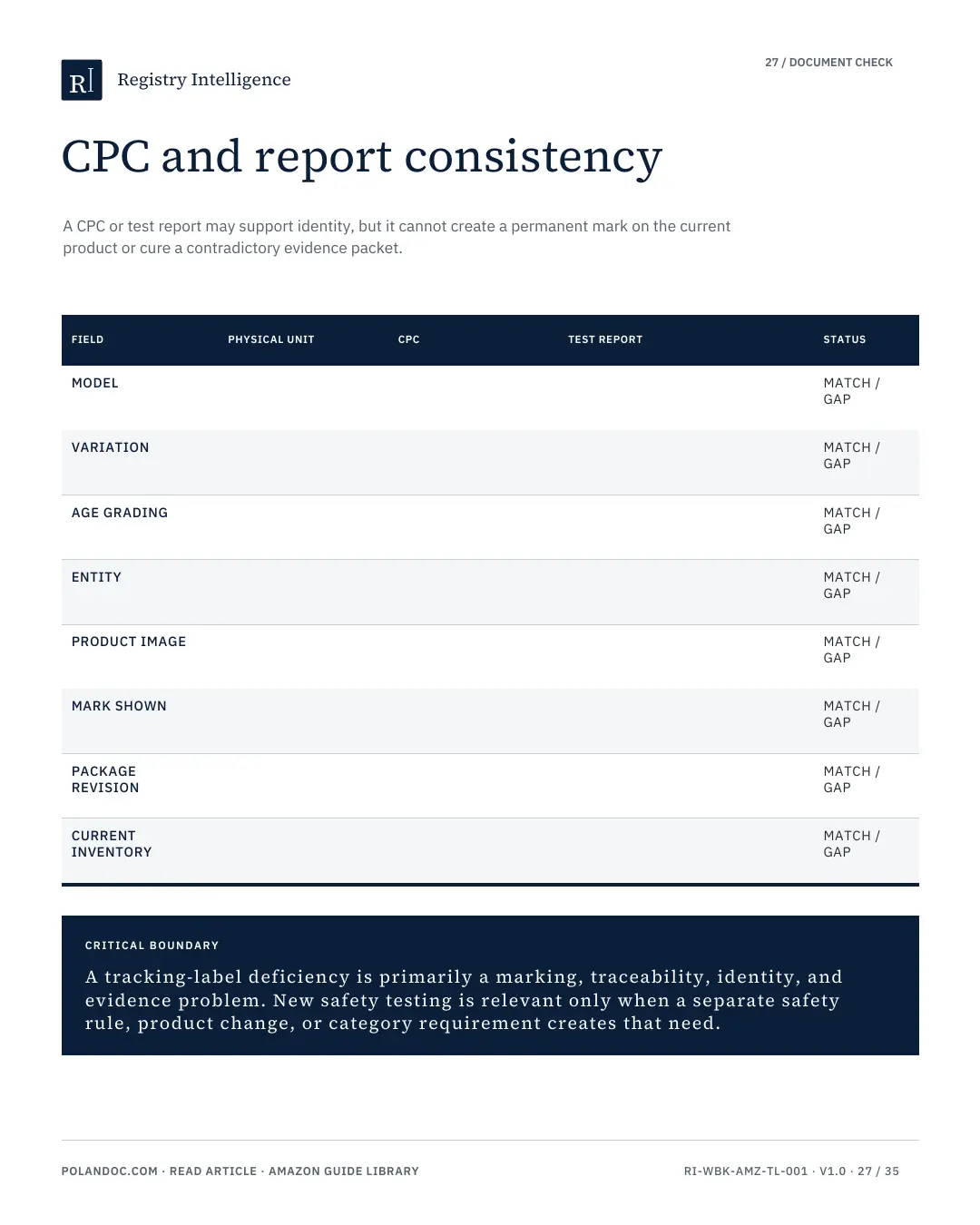
- CPC and report consistency
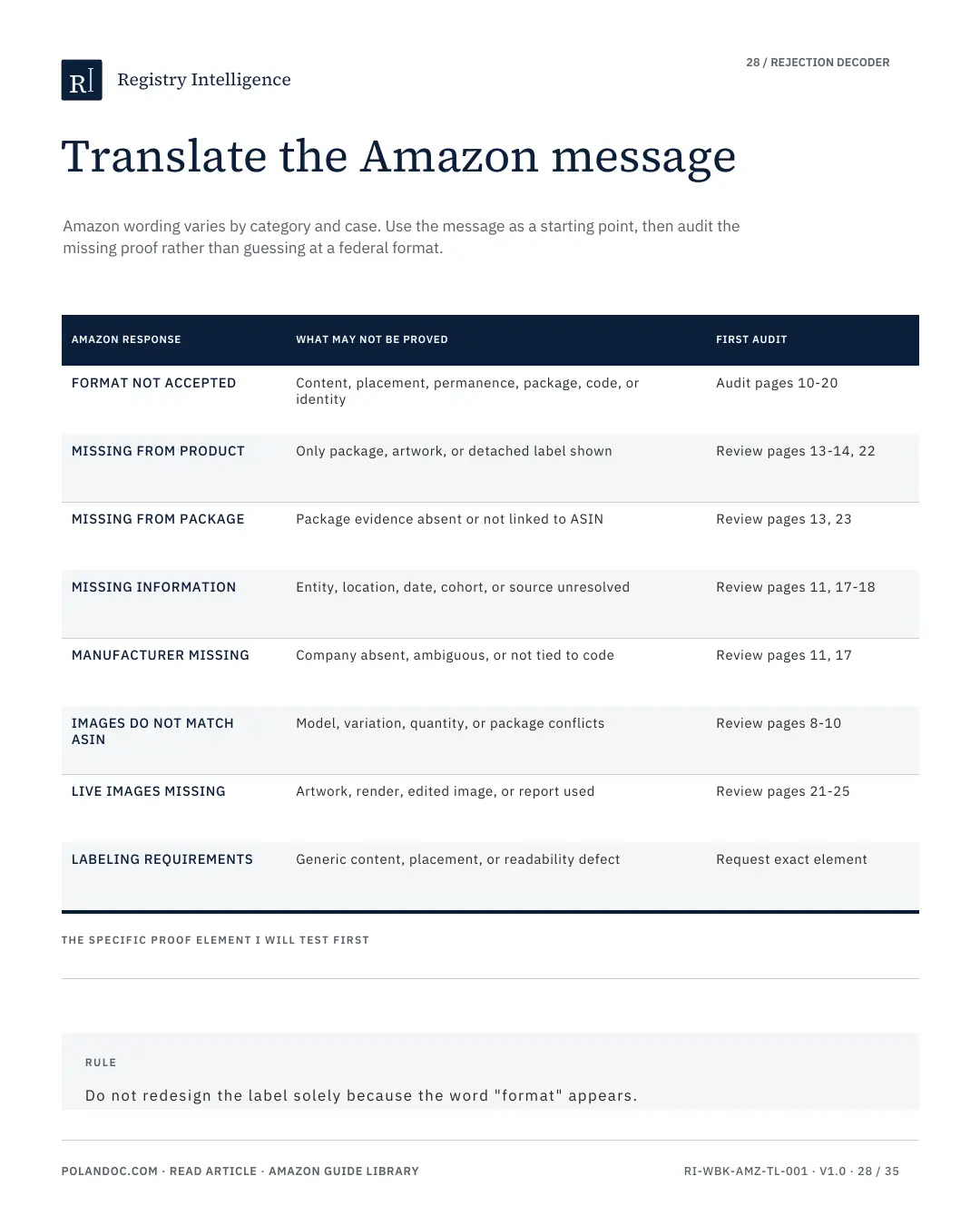
- Translate the Amazon message
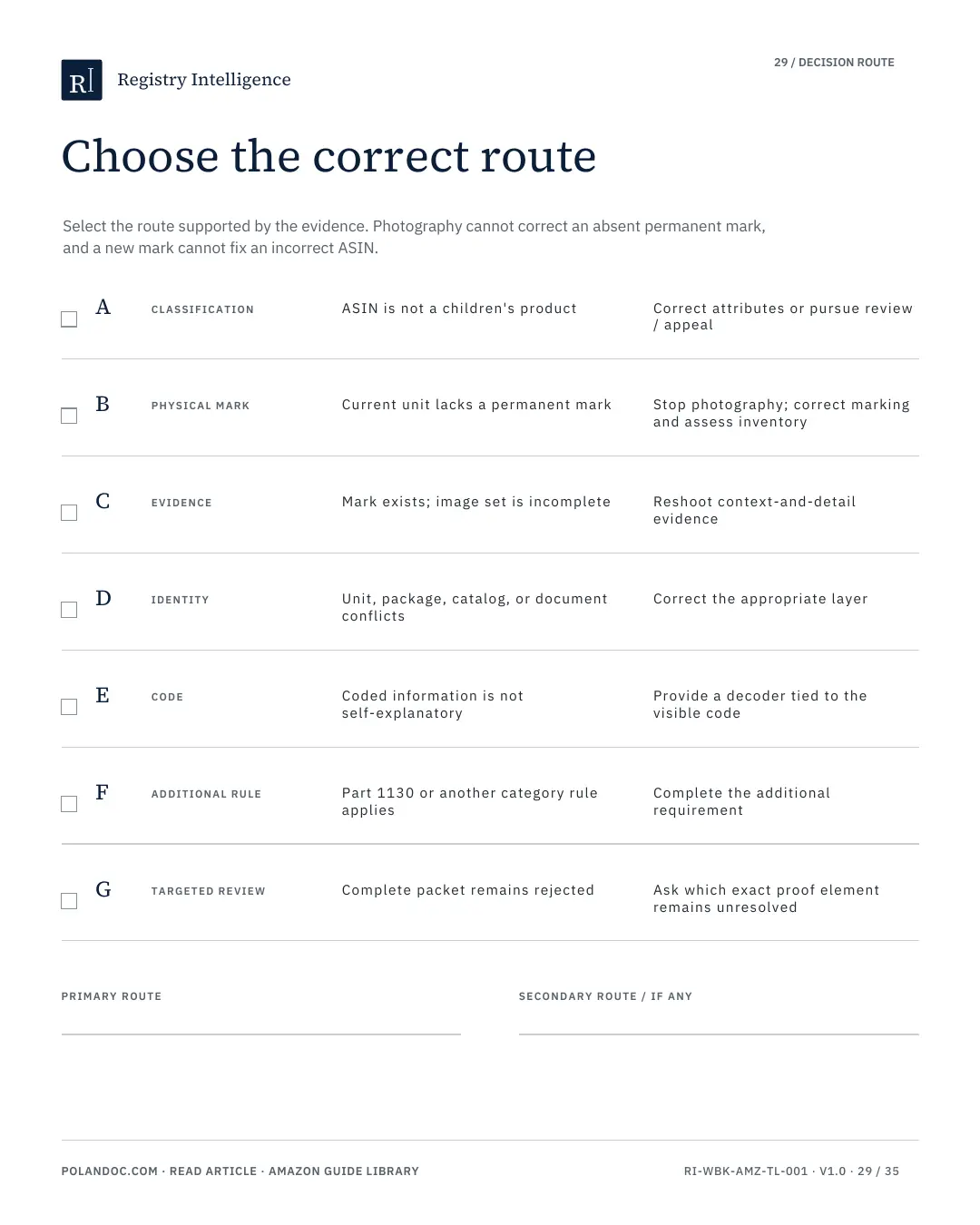
- Choose the correct route
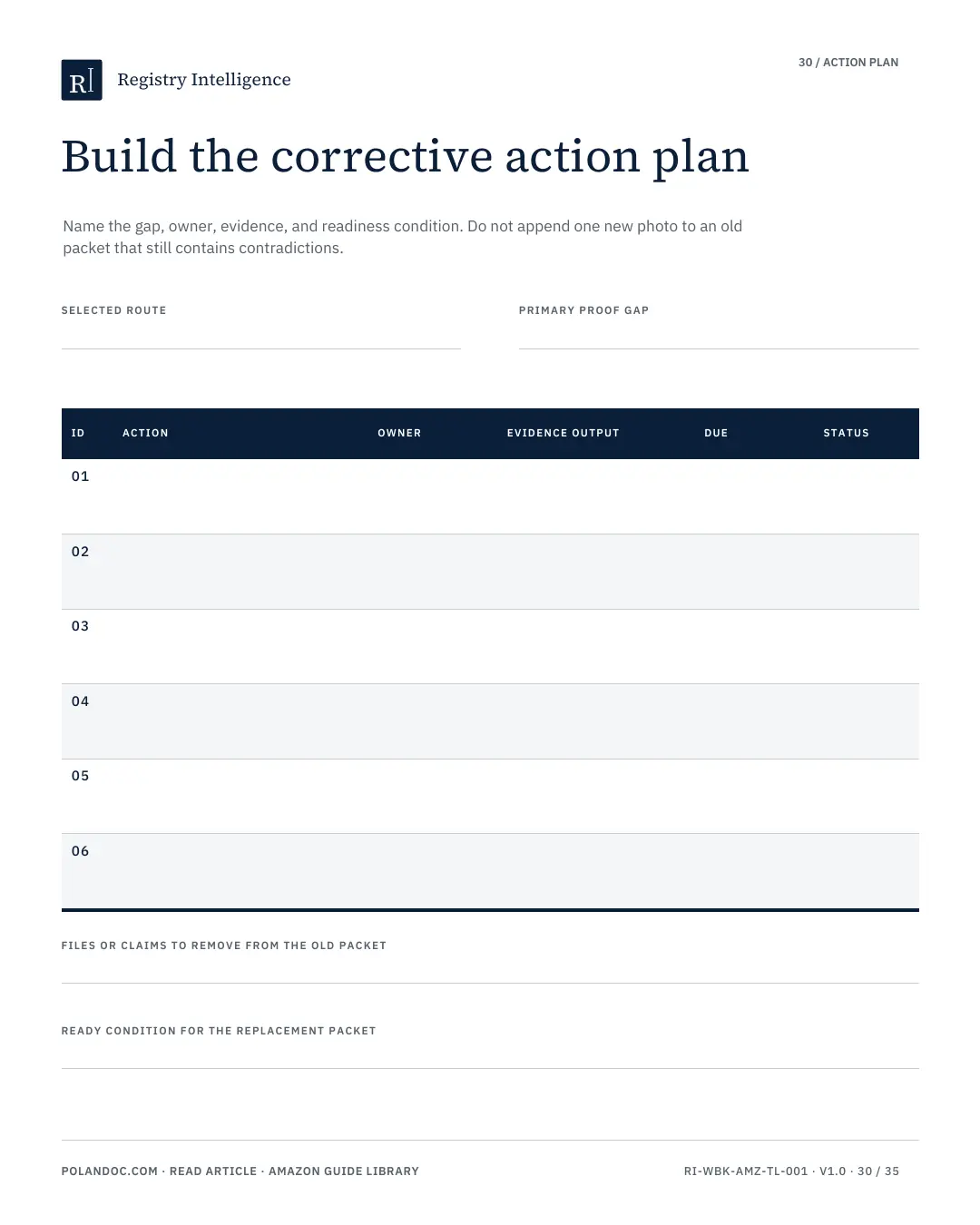
- Build the corrective action plan
- Pre-submission gate
- State what changed
- Preserve every submission outcome
- Official sources
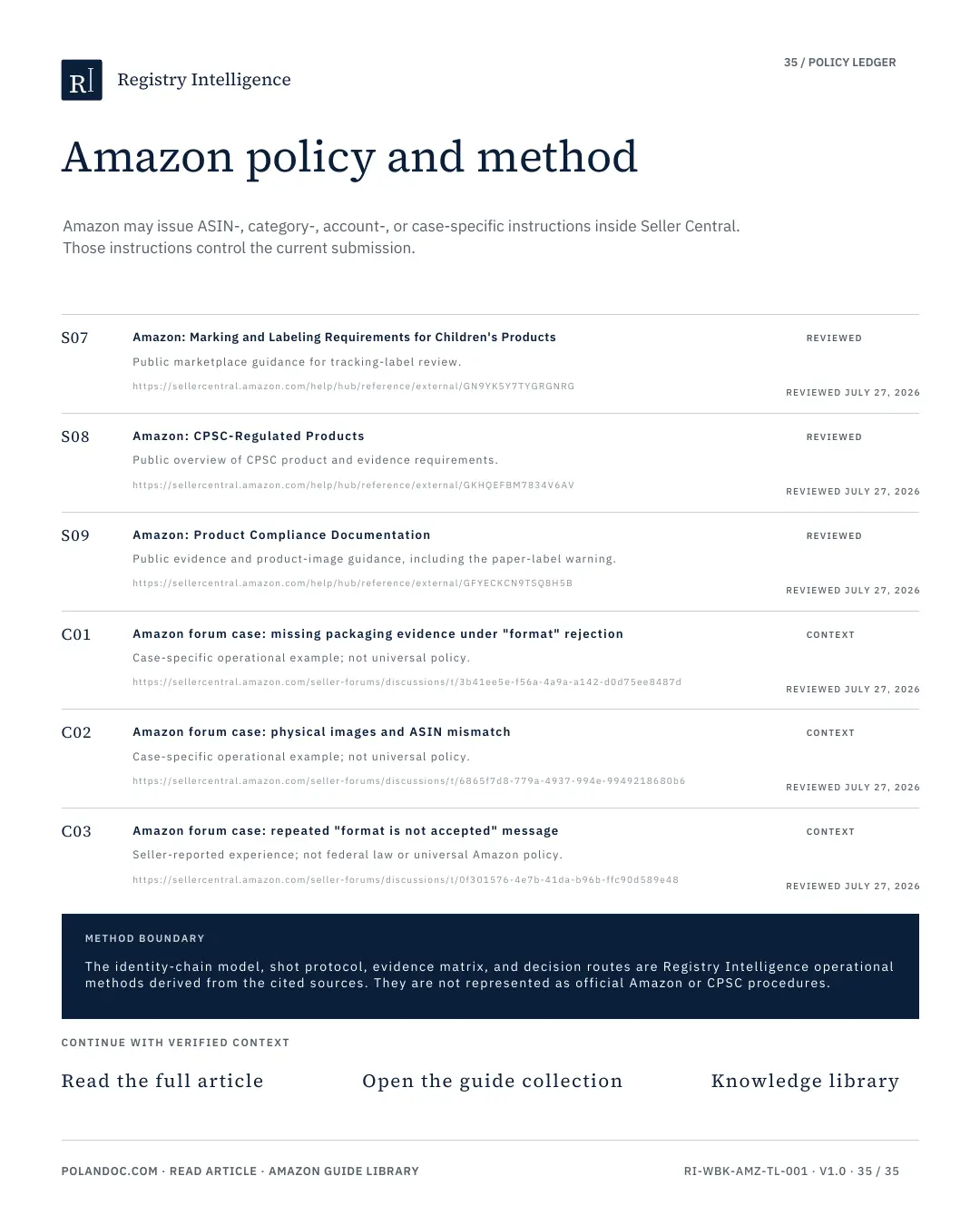
- Amazon policy and method
Research and editorial standard
How this mini-guide collection is maintained
Every entry is organized around a defined question, a visible source path, clear format boundaries, and a dated editorial review.
01
One defined question
Each mini-guide stays with a narrow seller, product, testing, or certificate issue.
02
Visible answer and source trail
The short answer, decision controls, detailed article, and primary sources remain available as HTML.
03
Dated editorial review
Each guide carries a review date and should be reassessed when a cited rule or marketplace process changes.