


Complex Administrative Procedures
Complex Administrative Procedures

Passport and Consular Procedures

Opening Bank Accounts Abroad

Strategic Audit of Complex Cases

Updating Passport Records

Verification of Data in State Registries
Key Solutions

“Reserve+”
Status and Regularisation within the “Reserve+” System

Embassy Appointment Booking
Arrangement of Appointments with Consular Authorities

Photo Insertion into Internal Passport
Updating the Photograph in the Internal Passport at Ages 25 and 45
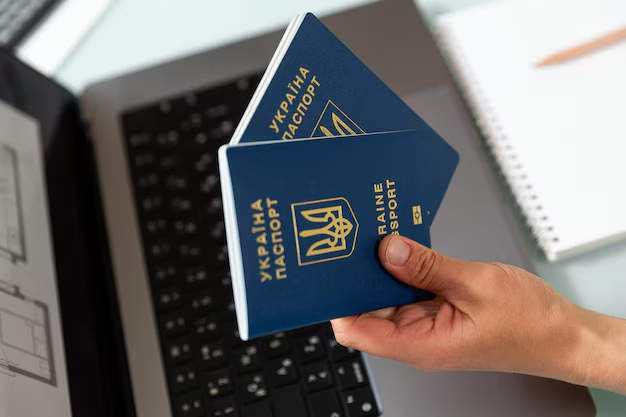
Ukrainian Passports
Issuance of Internal and International Passports

Expertise and Approach
Poland Documents is a Warsaw-based advisory service specialising in administrative and documentary procedures in Poland and across European jurisdictions. We handle complex cases where precision in legal status and the proper structuring of interactions with public authorities are critical.

50к +
Consultations

15к +
Satisfied Clients

100%
Successful Projects

Our Operating Principles

Expertise
We operate within procedures of heightened administrative complexity.

Transparency
We define the scope of services and terms of engagement prior to commencement.

Legality
We structure our strategies strictly within the framework of applicable laws and regulatory requirements.

Practical Experience
We manage cases involving a risk of refusal or procedural suspension.

News
Blog
 Arrest of Real Estate in Ukraine 2026: Types and Removal
01 March 2026
Arrest of real estate in 2026 is not a formal entry in the register, but a legal transaction block with distinct legal grounds: enforcement, tax, criminal, or sanctions-based.
This material analyses removal algorithms, judicial reasoning, and practical instruments for owners residing abroad. The article is structured as a decision-oriented framework.
 Selling Property in Ukraine in 2026 from Abroad: Digital Limits, Asset Seizures & Taxes
21 February 2026
Selling property in Ukraine from abroad in 2026 is legally possible — but only if digital risks are properly diagnosed in advance. Seizures in the State Registry, 18% taxation for non-residents, tax liens triggered by CRS data exchange, and notary refusal due to foreign powers of attorney can block a transaction at the final stage.
This guide explains how enforcement proceedings arise, why administrative fines transform into registration encumbrances, how tax residency is assessed on the signing date, and what must be checked before accepting a deposit. A structured roadmap for conducting a compliant remote transaction.
 “CRS Echo”: Automatic Tax Lien on Property for Overseas Account Debt
12 February 2026
Automatic CRS data exchange no longer remains abstract compliance. In 2026, undeclared foreign income can trigger a Tax Notification-Decision, coordinated tax debt and an automatic tax lien affecting Ukrainian real estate.
This analysis explains the legal chain under the Tax Code of Ukraine, when a sale is still possible, when it becomes blocked in the SRPR, and how timely due diligence prevents transaction collapse.

Request a Callback

Ukrainian documents abroad in 2026: Reserve+, passports, consular appointments, registries, and administrative risks
Author: Analytical Department of Poland Documents |
Updated: February 2026
Updated: February 2026
Institutional interaction between Ukraine’s state registries and consular missions abroad has reached an unprecedented level of digitalization. In 2026, the processing of Ukrainian documents abroad is no longer an isolated bureaucratic procedure. Today, it is a complex process inextricably linked to military registration status, tax obligations, and the citizen’s history of administrative offenses.
Previously fragmented databases (the Demographic Registry, the “Oberih” registry, and enforcement proceedings databases) now function within a unified cross-validation system. Any data discrepancy or the presence of a blocking status automatically suspends the provision of consular and administrative services. This material provides a systemic legal review of current administrative barriers restricting Ukrainian citizens’ access to basic rights outside the country and the methods of legal response to them.
Intended Audience for This Analysis:
- ✓ Ukrainian citizens (EU residents and non-residents) facing blocked consular services.
- ✓ Individuals whose military registration status prevents the issuance of passport documents.
- ✓ Individuals with complex administrative cases (registry data mismatches, administrative search status, enforcement proceedings).
Why 2026 Has Intensified Administrative Risks for Ukrainians Abroad
The transformation of the public administration system has led to a complete rejection of the “presumption of data relevance” principle. While previously the responsibility for updating information lay with the citizen and lacked strict preventive sanctions, the current e-government architecture applies the “no compliance — no service” principle (no actualization — no services).
Cross-registry interaction (via the “Trembita” system) ensures instantaneous verification of the applicant when contacting any foreign mission (SE “Document” or consulates).
Every application undergoes background verification against multiple criteria: from the validity of previous documents to the presence of the individual in the search databases of the Ministry of Internal Affairs and the TCC.
Key Factors in Rising Refusals: Military registration status abroad has become an absolute blocking factor for men aged 18–60. Failure to confirm the relevance of military registration data results in passport applications being moved to “no action” status or an outright refusal of service. In such cases, a preliminary analysis of the military registration profile is required and, if necessary, the removal of the administrative search status within the Reserve+ system.
Military registration status and the Reserve+ system as access factors
The functioning of the Reserve+ application and the electronic cabinet for persons liable for military service has radically changed the landscape of administrative procedures. Digital verification has become the primary stage of any consular interaction.
Impact of Status on Services
Legislation mandates that consular actions are contingent upon the possession of a valid electronic military registration document (QR code).
- Absence of data in the “Oberih” registry blocks access to the appointment system. In these cases, comprehensive activation and status regulation within the Reserve+ system are required.
- Discrepancies between factual data and registry records (address, status) require prior correction.
Blocking Statuses (Search)
The presence of a “wanted” (v rozshuku) status in the Reserve+ system is a critical legal barrier.
- This status is initiated automatically upon violation of registration rules.
- It precludes the possibility of remote passport acquisition or the execution of powers of attorney.
- It requires a separate legal procedure, including the removal of administrative search status in the Reserve+ system, prior to initiating passport services.
Passport procedures outside of Ukraine
The documentation process for citizens permanently or temporarily residing abroad is diversified but strictly regulated. Loss, damage, or expiry of documents while residing in another country creates significant risks for legal status (including the revocation of residence permits).
Processing ID Cards and Passports through Foreign Branches
The operation of separate branches of SE “Document” in EU countries has partially reduced the burden on diplomatic missions. However, the decision-making algorithm remains centralized. Processing an ID card and Ukrainian passport through SE “Document,” as well as issuing a single passport document through these service centers, requires prior validation of the applicant’s profile. If collisions are detected in the Unified State Demographic Registry (USDR), the passport issuance procedure is frozen at the personalization stage. Passport procedures cannot be initiated without comprehensive activation and status regulation in the Reserve+ system and confirmed Ukrainian embassy appointments in Europe.
Consular Routes and Restrictions
Consular registration and services remain a priority for individuals who have officially registered their departure for permanent residence abroad. For temporary residents, consulates apply a residual priority principle, resulting in an acute shortage of available slots. Additionally, consulates are authorized to refuse services in the presence of alimony arrears or unpaid administrative fines in Ukraine.
Passport Photo Updates (Ages 25 and 45)
Owners of 1994-style booklet passports face a legal collision upon reaching the ages of 25 or 45. The document is deemed invalid 30 days after the birthday. Legally correct passport photo insertion abroad is possible exclusively through consular institutions (SE “Document” does not perform this procedure, offering only an exchange for an ID card, which is not always advisable for the applicant due to tax residency reasons or the preservation of old TRN/RNUKPN stamps).
Consular Appointments and Digital Queue Systems
Access to consular institutions is administered exclusively through the “E-Cherha” electronic queue system. In 2026, organizational risks associated with the inability to secure a timely appointment have reached a critical level.
System Specifics: Slot allocation algorithms are unpredictable. The use of automated booking systems (bots) is blocked by the Ministry of Foreign Affairs’ anti-fraud algorithms, leading to shadow bans of the applicant’s profile in the authorization system (Diia.Signature or BankID).
Successful Ukrainian embassy appointments in Europe or at a consulate (including SE “Document” appointments in Poland) require constant monitoring and a valid digital identifier. The slightest data discrepancy during authentication results in the forfeiture of the right to receive the service, even where an appointment has already been confirmed. For repeated refusals or system blocks, a prior strategic legal audit of complex administrative cases is required.
State registries and data discrepancies
Administrative barriers most often arise not from applicant’s intent, but due to database desynchronization. The system does not tolerate technical errors.
| Problem Category | Administrative Consequences and Risks |
|---|---|
| Data Errors (Transliteration) | Discrepancies in the spelling of name/surname across various documents (internal passport, foreign passport, license). This leads to the automatic invalidation of one of the documents when registries are updated. To avoid collisions, official Ukrainian driver’s license confirmation is often required. Mismatched data in the license and passport may require simultaneous resolution during the issuance of passport documents. |
| Blocks (URDP and AISP) | The presence of unpaid traffic fines, TCC orders (fines under Art. 210, 210-1 of the Code of Administrative Offenses), or alimony in the Automated Information System of Enforcement Proceedings blocks the issuance of new documents and initiates the seizure of bank accounts. |
| Disconnection of the Tax Identification Number (RNUKPN) | A Tax Identification Number not linked to an actual biometric profile makes it impossible to use Diia services, generate electronic signatures, or authorize in banking applications. |
Bank accounts and identification abroad (KYC and AML)
For Ukrainian citizens abroad, the problem of legitimization concerns not only national documents but also financial integration. EU Anti-Money Laundering Directives (AMLD) impose strict obligations on financial institutions.
Financial Compliance Risks:
- Invalidity or expiration of a foreign passport leads to account freezing.
- Banks require documentary proof of source of funds (SOF) and tax residency.
- Absence of a residence permit (Karta Pobytu) places the client in the High-Risk category.
- Banking identification may also be blocked if there is an active administrative search status in the Reserve+ system.
To open a bank account in Poland without a residence permit, a legally verified strategy for providing documents (lease agreements, employment contracts, tax status confirmations) is required to pass automated KYC filters and avoid blocking under Art. 106a (in Polish jurisdiction).
When a strategic legal audit of the case is required
Established administrative practice demonstrates that attempting to resolve a complex administrative problem with piecemeal methods (e.g., simply trying to replace a passport while having a “wanted” status and enforcement fines) leads to the final blocking of the citizen’s profile.
Complex Administrative Cases
A combination of several risk factors necessitates a strategic legal audit of complex administrative cases. The audit includes:
- Verification of the individual against closed and open databases of the Ministry of Internal Affairs, TCC, and Ministry of Justice.
- Assessment of legal consequences regarding document expiration and statutes of limitation.
- Development of a step-by-step legal roadmap: from removing seizures/statuses to final legalization documentation.
Conclusion: A Systemic Approach to Legal Status
In the realities of 2026, the administrative status of a Ukrainian citizen abroad constitutes a complex mechanism of interdependent elements. An isolated approach to documentation (“simply replacing a passport”) is no longer viable. Consular procedures, digital verification within Reserve+, registry data integrity (including Ukrainian driver’s licence confirmation) and banking compliance collectively form a unified legal profile of the individual.
Ignoring the systemic nature of these changes inevitably leads to administrative barriers restricting freedom of movement, access to the financial system, and the right to lawful residence in foreign jurisdictions. Expert legal analysis and proactive management of registry data remain the only effective strategy for legal risk mitigation.
Professional Expertise and Audit
In the presence of aggravating circumstances (administrative search status, registry discrepancies, consular refusals), the engagement of specialised legal analysis is advisable in order to assess risks and design a structured rights restoration strategy.
Analytical Briefs (FAQ)
Is Reserve+ status a mandatory condition for passport replacement abroad?
Yes. According to current regulatory frameworks, a valid electronic military registration document (QR code) is a mandatory requirement for men of military age (18-60) when applying for consular actions and passport documentation.
What happens if the system detects a “wanted” status during document submission?
The application processing is suspended (“no action”) or a reasoned refusal is issued. The individual must resolve the cause of the administrative search status (through legal interaction with the TCC and SP) to unblock access to administrative services.
Can a photo be inserted into a 1994-style passport via SE “Document”?
No. Separate branches of SE “Document” are not authorized to perform photo insertions upon reaching 25 or 45 years of age. This procedure abroad is performed exclusively at Ukrainian consular institutions.
Why might a Polish bank block an account without a residence permit (Karta Pobytu)?
Blocking is driven by AML/KYC regulations. If a non-resident cannot confirm the legality of their stay (e.g., an expired passport) or the source of funds, the bank’s compliance algorithms classify the account as high-risk and restrict transactions until due diligence is completed.
What is the purpose of a strategic legal audit of documents?
The audit is necessary for individuals with complex cases (a combination of expired documents, problematic registry statuses, enforcement proceedings) to identify all hidden blocking factors and develop a legally sound algorithm of actions before contacting state authorities.
DISCLAIMER: This analytical material is for informational purposes only and does not constitute legal advice. Administrative practices, consular requirements, and registry algorithms (Reserve+, USDR) are subject to change. The presence of specific statuses is assessed individually during a legal audit.
© 2026 Poland Documents. All rights reserved.
Source: Poland Documents